How New IFRS Directions Impact Intangible Assets Reporting
Learn How New IFRS Directions Impact Intangible Assets Reporting
Intangible assets have become the dominant feature in the present knowledge-driven economy that bears relevance as business value drivers. Intellectual property, customer relationships, proprietary algorithms, etc are becoming more and more valuable than the actual physical resources and determine the value of a company. However, accounting standards internationally have not been able to capture these intangibles and were out of touch in measuring any of these intangibles.
The International Financial Reporting Standards (IFRS), which has been long criticized because it contains little guidance on the category of intangibles that lacks a reliable basis, is facing the pressure to make a change. Investors, regulators and other stakeholders are demanding a more thoughtful and transparent structure-one that would more accurately reflect the financial value of an economic enterprise.
For firms seeking accounting business valuation consultants Singapore with intangibles expertise, or individuals researching how to value intangible assets for accounting business, engaging the best intangible valuation consultants in Singapore becomes an essential step. This paper discusses the changing scenario of IFRS in the context with respect to intangible assets and explains the new avenues being pursued to enable adequate reporting.
The Current State of IFRS and Intangibles
Historically, the IFRS has been very conservative regarding the recognition of intangible assets. As per IAS 38 only intangibles which are identifiable to purchase in a business combination or to make separate purchase can be capitalized. This omits a substantial amount of internally-built assets (brand value, employee skills, and internally-created software) unless stringent asset recognition fulfills the requirements.
The main standards of recognition identifiability, control, and future economic benefit are frequently hard to meet when it comes to internally generated assets. This defensive stance assists in avoiding overvaluation and at the expense of understatement of valuable non-material assets. Consequently, the actual sources of competitive advantage can be hard to relate with the balance sheets.
This disjuncture is most telling in such industries as technology, pharmaceuticals, and media, where the core of the business model is based on the intangible assets. A company may have a dominant position in the marketplace because of brand equity or own technology but have a conservative asset base on a company balance sheet.
Why Change Is Necessary
There has been concern over the restriction of the existing IFRS framework. Accounting reports that neither capture the true value of a company in terms of intangibles fail to provide pertinent insight into the investments made. They are also detrimental to the possibility to compare the firms that develop organically and those that grow through acquisition.
Also, the emergence of digital-first business models has brought with it assets- e.g. data analytics capabilities, machine learning algorithms and network effects)-which do not fit into conventional accounting buckets. These trends make it evident that a more flexible and modern reporting system needs to be developed.
Investors, analysts, and regulators have called for reforms that enable:
- Greater visibility into internally developed intangibles
- Consistent treatment of similar assets, whether acquired or developed in-house
- Enhanced comparability across companies and industries
- Risk assessments based on asset quality and innovation potential
New Directions Under Consideration
With a realization that this has flaws, the IFRS Foundation and other international regulatory organizations occupying the same field of research have started revisiting the approach to the treatment of intangibles. The suggested or contested directions involve some of the following:
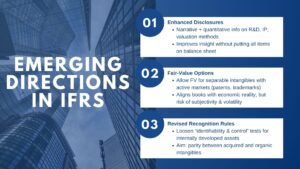
1. Enhanced Disclosure Requirements
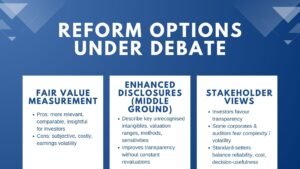
The enhancement of disclosure requirements is one of the least disruptive courses of action that is under consideration. Instead of requiring that all intangibles be recognized on the balance sheet, the approach shows more emphasis on requiring that the entities that disclose considerably more information in financial disclosures reveal the note.
This may involve narrative provisions of major intangible assets, the level of investment in both research and developments, the type of intellectual property, and the system of valuation applied in the internal decisions. In a form of disclosure not desirable in the sense of maintaining balance sheet accuracy, better disclosure would at least present the user with a clearer view of the scale of intangible value.
2. Fair Value Measurement Options
There is also route which entails allowing and requiring to measure fair value of particular intangibles, particularly those that are separable and have measurable market transactions. This would be a more volatile way of accounting but it would also be a way of getting finance more at line with economic reality.
To the limited group of intangibles subject to strict reliability tests, e.g. patents where the licensing markets are active or trademarks with recorded royalty streams, fair value might be used. The difficulty is that it is essential to have consistency and reduce the level of subjectivity in evaluation methods.
3. Revisiting Recognition Criteria
There are experts who believe that the criteria of recognition provided in IAS 38 should be completely restructured. This may include easing off the rigid terms of control and identifiability and as such have increased internally grown intangibles to be captured.
This change would need to be strongly guided to ensure that the abuse is avoided, however, any such change would drastically increase the representational faithfulness of financial statements and particularly to innovation-heavy businesses.
The Role of IFRS 3 and Business Combinations
Interestingly, IFRS 3 already allows recognition of a large diversity of intangible assets on business combination, which includes, customer relationships, proprietary technologies, and trade names. This brings up the issue of having an inconsistent treatment of the internally created and acquired intangibles.
Terminating this asymmetry is among the main objectives of the reform initiative. A convergence foundation which considers similar assets in a standard fashion irrespective of the acquisition method would increase the comparability and lessen weapons of earnings management through acquisition accounting.
Implications for Stakeholders
The evolution of IFRS reporting for intangible assets will have far-reaching implications across the financial ecosystem:
For Companies
It will force organizations to change their internal reports, as well as valuation models. Companies with considerable expenditures around R&D and brand development would be useful to be able to reflect such commodities in their balance sheets. Yet, this may translate to the greater scrutiny of audit and complexity of valuation as well.
For Investors and Analysts
There can be the development of greater disclosure on intangible assets, and the assessment and benchmarking of the company will be done more accurately. It will also decrease the dependency on non-GAAP numbers or external figures in order to know the intangible value driver firm.
For Auditors and Valuation Experts
This trend of increased disclosures and subsequent measurement in the form of fair value is going to raise the place of valuation specialists. Accountants will require some new frameworks and tools to assess verifiability and rationality of intangible asset valuations by auditors.
Challenges and Risks of Implementation
Despite widespread support for reform, significant hurdles remain. These include:
- Measures Uncertainty: The intangible assets normally do not have active markets and the valuing process can be very subjective.
- Comparability Trade-offs: Greater recognition of assets will have the possible detrimental effect of reducing comparability in the case where companies incorporate varied estimates of value.
- Cost of Compliance: Bigger companies can afford the expenditures of fair value measurement or additional disclosures, whereas the smaller ones cannot.
- Auditability: Auditing intangible assets that are generated internally gives the auditors difficulties particularly because of having to rely on future projections made by management.
These concerns suggest that any reform must strike a balance between relevance and reliability. The objective should be to enhance transparency without undermining the integrity of financial reporting.
Global Coordination and Next Steps
Since financial markets belong to the global market, the changes in the reporting of IFRS on intangibles should be coordinated across the various jurisdictions. Already, the IASB has established research projects and stakeholder consultations to provide views on how best to proceed.
Parallel discussions are also occurring at the U.S. Financial Accounting Standards Board (FASB), particularly in light of how software development costs and digital assets should be dealt with. Alignment between the IFRS and U.S. GAAP will be critical in deterring the possibility of regulatory arbitrage and global comparability.
We shall see both short-term adaptations (e.g. disclosure improvements) and long-run reform (as e.g. in possible amendments to IAS 38). The feasibility and effects of new models can be tested on pilots and under field after which full scale implementation can be achieved.
Conclusion: How New IFRS Directions Impact Intangible Assets Reporting
The intangible assets have become too big to fit into the models that were developed to track them. The rising role that intellectual capital, digital innovation, and brand equity play on contemporary business models require and necessitate the concomitant development of financial reporting.
Although better reporting is easier said than done, the road seems to be evident. The stakeholders desire transparency, uniformity, and kinship in reporting of intangible assets. The new IFRS guidelines seek to harmonize the differences between the financial statements which have been in use and the value drivers of the future economy.
To the companies, this will be a chance to exhibit themselves better in terms of their actual value. To investors, it is an opportunity to make better decisions. And to the standard setters, it is a moment of fateful opportunity to re-write the language of value in a new world.
Frequently Asked Questions
Q1. Why are changes to IFRS for intangible assets being considered?
Changes are being considered because existing IFRS standards do not fully capture the value of many internally generated intangible assets, such as brands, proprietary technology, customer relationships, and data-driven innovations. Updated guidance aims to improve transparency, comparability, and the relevance of financial reporting in today’s knowledge-based economy.
Q2. How could new IFRS directions improve intangible asset reporting?
Proposed IFRS developments may introduce enhanced disclosure requirements, broader recognition criteria, and expanded use of fair value measurement for certain intangible assets. These changes could provide investors with a more complete understanding of a company’s intangible value and long-term growth potential.
Q3. What challenges could companies face under new IFRS reporting requirements?
Companies may face challenges such as estimating fair values for assets without active markets, preparing additional disclosures, maintaining consistent valuation methodologies, and meeting increased audit and compliance requirements. Smaller businesses may also experience higher implementation costs.
Q4. How do the proposed IFRS changes benefit investors and analysts?
Improved reporting on intangible assets helps investors and analysts better evaluate a company’s competitive advantages, innovation capabilities, and future earnings potential. More transparent disclosures can reduce information gaps and support more informed investment decisions.
Q5. Will the new IFRS directions replace IAS 38 and IFRS 3?
No. Current discussions focus on improving and updating existing standards rather than replacing IAS 38 or IFRS 3 entirely. Future reforms are expected to enhance recognition, measurement, and disclosure requirements while maintaining consistency with the overall IFRS framework.