Certified Trademark Portfolio Optimization Course
How Trademark Portfolios Can Be Optimised for Global Licensing Income
Introduction to Certified Trademark Portfolio Optimization Course
Trademarks are one of the least commercialized types of intellectual property in a world where intangible assets have been major contributors to disproportionate corporate value. Companies mostly consider the trademarks as protection mechanisms, which serve the purpose of preventing imitation or protecting the brand name, but there is so much more in terms of the economic potential of the trademarks. Maintained portfolios of trademarks may also be revenue generators, especially when they are designed to be licensed internationally.
International brands, middle-level companies and even innovators of consumer goods are becoming more aware that to optimise trademarks monetisation, registration is not sufficient. It requires tactical organisation, market prioritisation and rigorous portfolio management. Strategic Intangible Disclosure Attracting Investors further enhances the value and appeal of trademarks to global stakeholders.
This paper concentrates on a single area which is how companies can optimize their trademark portfolios to maximize global licensing revenue so that brand assets can become predictable long-term sources of revenue.
1. Trademark Portfolio Monetisation.
1.1 Developing a Portfolio that is designed to license, rather than protect.
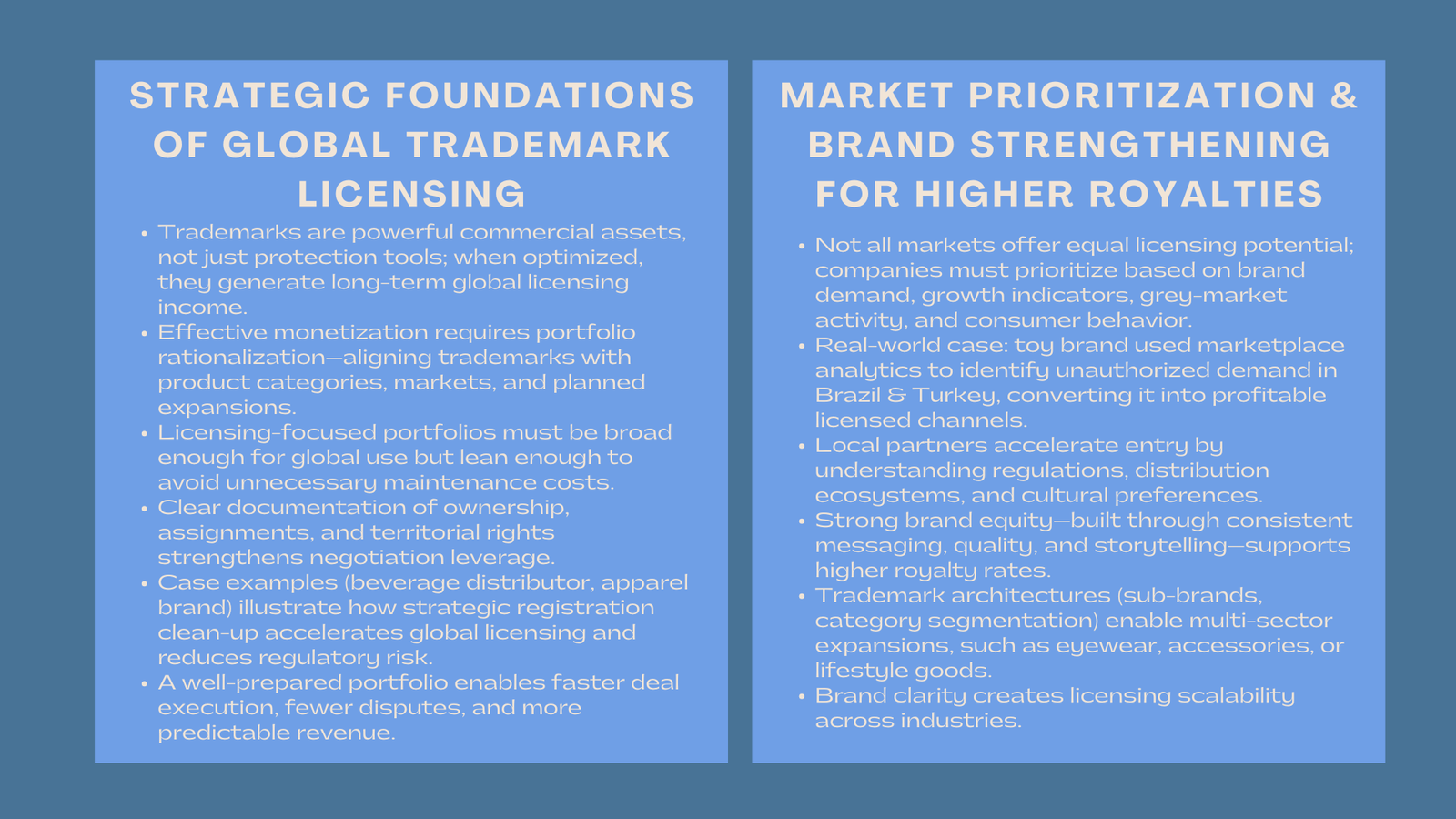
Companies are known to acquire trademarks as they go, registering a logo, slogan, or product names in response to the need. Nonetheless, the monetisation-based strategy starts with the rationalisation of the portfolio to provide a certain correspondence between the trademarks, product categories, and target markets. The portfolio that has been optimised to achieve licensing needs to be robust enough to carry the international expansion, but it should be lean enough not to incur on the maintenance costs that are unnecessary.
As an illustration, a distributor of beverages based in Southeast Asia, which sought to grow its business by franchising, realised that its trademarks were registered in its home countries under only classes. The diversified licensing channels were developed by the company through its strategic expansion of the protection into food service, merchandised goods, and digital marketing classes. This forward-looking harmonisation has allowed partners in the Middle East and Europe to obtain rights without any issues, which allows the speeding up of negotiations and reduced regulatory risks.
Such portfolio preparedness forms the backbone of an effective international trademark licensing strategy, ensuring that brands can be licensed quickly and legally across multiple jurisdictions.
1.2 Clarifying Ownership, Territories, and Rights to Support Negotiations
The ownership or registration status can buy and sell ambiguity, which derails licensing opportunities. Companies that are about to globalise their funds have to record chain of title, history of assignments, licensing precedence and coverage of territory in a tabular way.
Take the example of an international clothing and accessories company that found out that there were inconsistent ownership records in Latin America as a result of historical distribution agreements. Prior to initiation of a global licensing programme, the company had taken part in a multi-year clean-up exercise- consolidating ownership, reinstating lapsed registrations and harmonizing classes. This initiative brought back sanity in the law and a lot of strength in its bargaining power with potential partners.
A clean and well documented portfolio sends a message of professionalism, lowers the hurdle of negotiation and chances of closing a licensing deal on favourable terms are high.
2. Putting Markets First in Maximum Licensing Value.
2.1 Discovering the High-Potential Markets with Credible Data Signals.
The monetisation potential is not as significant in every jurisdiction. The criteria that the companies should use to prioritize the regions include the demand of the brands, the growth rates of the categories, consumer behaviour, and competitive saturation. Data which is industry specific, the number of trademark filing, and grey-market actions can serve as precursors of demand.
Indeed, online marketplace analytics allowed a children toy brand with its headquarters located in Europe to realize that its products were being resold in large quantities in Brazil and Turkey without licenses. The company did not merely treat this as a counterfeit matter, but it examined the demand indicators and employed them to create licensing partners who were authorised in both nations. The revenues of licensing rocketed, and unauthorized sales decreased dramatically owing to enhanced ground presence of brands.
The strategic market selection will make sure that resources are pooled where the monetisation potential is high.
2.2 Tapping into Local Associates to Fast-track Market Access.
The most frequent way of increasing the licensing income is when the companies join local organizations who are aware of the regulatory opportunities, the distribution channels and the preferences of the consumers. Such alliances enable the brands to grow without the involvement of operational investments.
A Scandinavian-based premium homeware firm entered into territorial licensing contracts with local distributors in the Middle East. In providing exclusive rights backed by stringent brand guidelines it allowed partners to tailor product lines to local design sensibilities and retain international brand consistency. The outcome was a high rate of revenue at low risk and no obligation of manufacturing.
The right partners convert trademark value into commercial momentum across geographies and licensing is a high-paying, low capital expansion model.
3. Strengthening Brand to raise the Lisensing Fee.
3.1. Creating Brand Equity by Being Consistent and Storytelling.
The licensing partners are paying premium on the trademarks that resonate well on the market. Firms that have continually communicated in the same way, visually, and delivered the same quality products are in a position to charge them higher royalties and negotiate better terms.
One Japanese sportswear company that was only operating within domestic stores redesigned its international advertising as one cohesive digital campaign and brand content. The improved brand image enabled it to have international licensing deals based on royalty rates that were almost twice the industry rate. Brand consistency was an economic lever that could be measured.
3.2 Portfolio Architecture to Support Multi-Sector licensing.
Powerful brands tend to expand into other related categories – clothes, household products, accessories, perfumes or online content. The expansion is facilitated by a coherent trademark architecture which outlines specific sub-brands, product lines or lifestyle segments.
An example of this strategy can be an example of a luxury automotive manufacturer. Although it was the main provider of the performance vehicles, it used its brand name to penetrate eyewear, leather products, and watches. The company provided industry-specific licensing packages to premium manufacturers by dividing the sub-brand trademarks into each category. These extensions increased revenue streams and reached more brand space without reducing core identity.
An effective brand architecture offers clarity to both the licensees and the consumers so that it is easy to expand into new verticals on a scale.
4. Adopting Governance Models to secure Royalty Streams.
4.1 The development of Enforcement Systems that protect Licensed Value.
Licensed trademarks may be undermined by unauthorised usage, fakes, or poor product quality and decrease royalty payments. The companies that aim at achieving sustainable monetisation need to implement organised models of governance that entail monitor and audit with compliance mechanisms.
An international cosmetic company installed an online trademark monitoring system that was combined with the takedown tools of e-markets. This minimized the infringement by more than 60 percent in one year and elevated brand integrity and confidence of licensees. A high IP enforcement will assure the genuine partners that their investment within the brand will remain secure.
4.2 Ensuring Strong Quality Controls within Jurisdictions.
Value in Trademark cannot be separated especially in product quality. The licensee should adhere to elaborate brand manuals, quality and packaging requirements more so in industries such as health, food, cosmetics, lifestyle products, and those that deal with children.
An European lifestyle brand, having extended the license to Asia, adopted a value of compulsory quarterly quality audit and electronic reporting dashboards. Strict technical requirements of materials, labelling, and sustainability were observed by the licensees. The brand therefore retained high-end status in the markets and acquired long term renewals of licensing rates of increased royalty.
Quality governance enhances the brand image and enhances the profitability of a licensing.
Conclusion
The reason behind having to optimise trademark portfolios in order to globalise the trademark licensing revenues is more than merely about having to ensure that the trademark is registered- it is about portfolio design, market focus, brand building and focused governance in the different jurisdictions. When properly implemented, trademarks become both effective legal property and a significant commercial engine that will bring about recurring, scalable and cross-border income.
Companies that perceive trademarks as commercial property and not administrative costs enjoy a high competitive advantage in a market place which is increasingly global. Brands can generate the maximum business potential of their intellectual property and open up long-lasting revenue streams in the global market with the help of proper structures, collaborations, and portfolio discipline.
Frequently Asked Questions
Q1. How can companies optimize trademark portfolios for global licensing?
Companies can optimize trademark portfolios by registering trademarks in key markets and product classes, maintaining clear ownership records, strengthening brand consistency, and developing licensing strategies aligned with international expansion goals.
Q2. Why is trademark portfolio management important for licensing income?
Effective portfolio management increases legal protection, simplifies licensing negotiations, supports international market expansion, and helps maximize recurring royalty income from licensed trademarks.
Q3. What factors should businesses consider before licensing trademarks internationally?
Businesses should evaluate trademark ownership, registration status, territorial protection, market demand, potential licensing partners, local regulations, and brand reputation before entering international licensing agreements.
Q4. How does strong brand equity increase trademark licensing value?
Brands with strong recognition, consistent quality, and customer loyalty can command higher royalty rates, attract premium licensing partners, and expand into multiple product categories more successfully.
Q5. How can companies protect trademark value after licensing?
Companies should implement trademark monitoring, enforce intellectual property rights, conduct regular quality audits, establish clear brand guidelines, and monitor licensee compliance to preserve brand value and long-term licensing revenue.