Turning Proprietary Processes Into High-Value Certifications
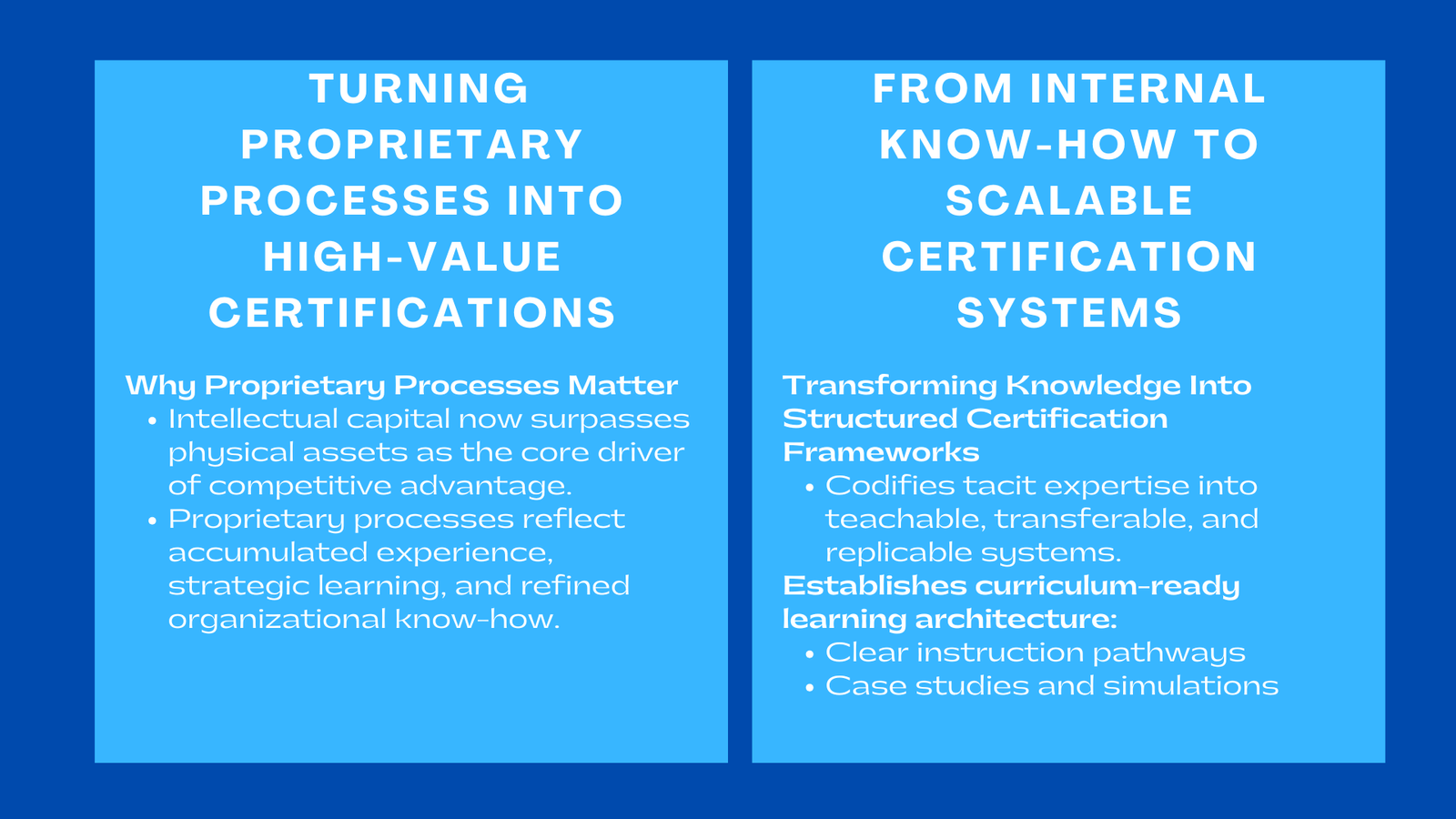
With the ever changing global enterprise environment, intellectual capital has overtaken the physical capital as the greatest resource an organization can have. Companies are increasingly becoming economically strong not based on the machines it possesses and size of its employees but rather based on the complexity of its knowledge system, uniformity of its internal procedures and the brand of expertise under which it is operating. Proprietary processes, the special, evolved and deep rooted, ways of doing things that make one organization unique to another, are the quintessence of intellectual DNA of an organization. They encompass years of trial and error, perfection and strategic learning. Put as certification schemes and processes, such proprietary processes are no longer operational devices, but scalable intellectual properties that could be monetized, licensed and institutionalized across the industries.
The competition pressures around the globe compel companies to become meaningful in the way they distinguish themselves. It is possible to duplicate products, steal employees and technologies are rapidly changing. However a proprietary process and particularly a refined one which has been successfully tested over years is simply hard to replicate by the competitors. It is not merely knowledge but also cultural, intuitive, strategic and organizational wisdom. As the industries change to framework systems, standards, and certification based trust, organizations have realized that, transforming their processes of proprietorship into certifications will broaden their power, opportunity to build their brands as well as create sustainable revenue streams. Certifications bring internal processes to a standard that is how to convert proprietary processes into market-recognized certification programs recognized in the industry and this has enabled the organizations to promote practices of professionals way beyond their organizational reach.
Understanding Proprietary Processes as High-Value Intellectual Systems
The Depth and Complexity of Knowledge Embedded in Internal Workflows
Proprietary processes are full of tacit knowledge which is knowledge gained out of experience and not taught by a teacher. Such learnings may go through years of time and may just be in the minds of the specialists or in the culture of the organization. Nonetheless, the tacit knowledge has been found to be one of the best aspects of intellectual capital owing to practice in real-life skill. This knowledge can be extracted and codified, and this is a source of power for certification programs. The end product is more of a certification and the more refined and tested the process the more is considered valuable. These processes represent their own style of choreography of choice, strategy implementation, quality control and technical capabilities. These holistically show the way in which an organization thinks, behaves and problem solving, especially when aligned with in-house employee training Singapore customised courses that help reinforce and scale such proprietary expertise.
The Transformation of Tacit Knowledge Into Scalable Intellectual Property
Codification converts unnoticed knowledge that is based on practice to regular systems of knowledge which can be learnt and used by others. This is done through a step-by-step manner of documentation, identification of the key principles, expression of the evaluation criteria and explanation of the logic that has been used to underpin every point of the decision. Knowledge which is codified is transferable and scalable thus allowing organizations to package their excellence as a business inside their four walls into certification which can be taught. This change is not just a matter of administration- that is, it is a strategic move of making intellectual content an intellectual property. The codification of the process brings new aspects of value: it is commercially viable, operationally replicable, and legally defensible, and has the global distribution.
Structuring Proprietary Processes Into Robust Certification Frameworks
Architecting Methodologies Into Curriculum-Ready Learning Systems
The way to address proprietary processes so as to transform it into the certification is to rebuild it into a learning architecture supporting clear instructions, measurable results and structured evaluations. These incorporate determination of order of introduction of concepts, creation of case studies of application, the incorporation of simulations of reality and evaluation tools to measure proficiency. A certification is not merely a training program – it is an established system of competence certification. Thus, the proprietary process should be designed such that the learners do not just learn the process they can also unify it and effectively use it in the future.
Developing Multi-Level Certification Pathways That Support Deep Expertise
Multi-layered certifications are usually of high value. An initial certification parametrically involves introduction on concepts. An application skill is enhanced at a practitioner-level certification. The certification on the level of master trains to teach or audit the methodology. This is a three-level procedure that expands the duration of the certification and upholds a sustainable business case. Individuals become committed towards moving up through the ranks and the employers promote the constant rise and higher levels to enhance company performance. Also in the multi-level pathways, the certification is also able to develop within industries, cultures, and job descriptions thus developing a general framework that is flexible to varying contexts.
Transforming Internal Methodologies Into Market-Recognized Credentials
How Certifications Convert Processes Into Professional Standards
The proprietary processes move past becoming in-house intellectual ergonomics over to a recognized certification in the industry. Such a change brings the organization to a level of being thought leaders and not merely a market player. The professionals and the businesses initiate the process of conforming their practices to the certified methodology which makes the intellectual system of the organization part of their working processes. This institutional adoption eventually powerfully makes the proprietary process a standard of professional competence. The certification is transformed into the indication of credibility, competence and compliance to industry best practices. This is one of the strongest effects of certification-based intellectual property that would drive long-term value.
Integration Into Corporate Talent Development and Institutional Learning
Competency-based training is being heavily used by organizations to ensure a unified quality in their training programs, decrease risks, and increase the labor force capability. When a proprietary process is developed into a certification, it is a natural option to any company that tries to have structured forms of development. Such an integration forms repeat demand. The employees in every new generation are to be certified. The employees who are already in place will have to re-validate their credentials. Managers should undergo certification of the level of leadership. Complete departments can be certified to refreeze the practices to the industry standards. Possibly through institutes, undergraduate programs, career development, and professional, professional diploma programs, allow institutions to make the proprietary method relevant on a long- term and multi-generational basis.
Licensing Proprietary Certifications for Scalable Revenue Generation
Building Recurring Income Through Licensing Agreements
One of the most profitable types of ways of monetizing certifications is licensing. Training institutions, consulting firms, educational providers or individual instructors can be licensed by organizations to provide certification programs. The licenses provide continuous income consisting of annual fees, exam rights, royalty and recertification fees. Another effect of licensing is the dramatic extent of reaching the world. Every licensed partner turns into a distribution channel through which the methodology can be spread and allows being consistent with the quality and brand standards. Licensing itself makes the proprietary process replicable and capable of scaling not only within industries but also between continents.
Sublicensing Networks as Engines of Global Market Penetration
Sublicensing provides the opportunity in the creation of a multi-level distribution system in organizations. One of the masters in a region can sublicense the methodology to other local partners. This design forms a flow of revenue streams, but on a centralized quality control. The networks of Sublicensing may expand exponentially, allowing the certification to penetrate into new markets very fast, without demanding the IP owner to construct large internal training infrastructures. In the long run, there is a worldwide chain of approved coaches, facilitators, and establishments that will develop into a living ecosystem that keeps on spreading the proprietary methodology.
Protecting Certification-Based Intellectual Property
The Role of Legal Protection in Maintaining Certification Integrity
Laws facilitate the value and protectability of certification-based IP greatly. The teaching material is defended by copyright. The trademarks safeguard the certification name, branding, and other identities of credentials. Certain confidentiality agreements are used to protect unpublished aspects of the methodology. The use terms and obligations, as well as right of renewal are stipulated in the licensing contracts. These forms of law also make sure that the proprietary process is still limited, authoritative and financially desirable. Effective protection also gives the licensees, institutions and learners the strength of confidence that the certification has some legitimacy and that the certification is under enforceable intellectual property laws.
Ongoing Enforcement to Prevent Dilution and Maintain Market Value
Exclusivity and integrity are the sources of value of certification programs. Both are diluted by unauthorized usage. Consequently, companies need to take active measures of enforcing the IP rights by monitoring, compliance audit, litigation and quality analysis. This is enforced to make sure that it is only certified trainers and institutions that are providing the methodology so that the standards remain the same and that fake or poor quality versions of the certification do not find their way into the market. With the active defense the certification can preserve its prestige and its long term commercial feasibility.
Building Ecosystems That Amplify Certification Longevity
Creating Global Professional Communities That Sustain Certification Demand
The most triumphant certifications are the centre of vividly professional communities. Such communities are a place of sharing knowledge, conferences, research contributions, growing of the methodology and a feeling of belonging to the certification. There is an increasing impact of the certification along with the growth of the community. It is a cultural icon of greatness not just a qualification. The community supports the relevance of the methodology, increases the organic demand and brings power to the certification in the long run. This interdependence effect converts the certification as an agency of the profession creating more and more commercial and intellectual value each year.
Innovation as the Lifeline of Certification System Relevance
The certifications will have to change with the trends of the industry, emerging technologies, new regulatory trends, and new best practices. The Innovation process makes the methodology not outdated and makes sure that the learners still pursue recertification or advanced modules. The organizations have the opportunity of introducing new frameworks, new additions in specializations, new delivery formats, worldwide adaptations, digital forms of learning, and high-grade diagnostics tools. This perpetual innovation is what is shifting the proprietary process into a dynamic and constantly changing intellectual ecosystem instead of the training product. It delivers multi-generational relevance and makes the certification a future acceptable knowledge standard.
Conclusion to Turning Proprietary Processes Into High-Value Certifications
One of the most strategic and scalable methods of organizations to make money out of their intellectual properties is to use it as certification. Certifications transform internal excellence into international influence in such a way undocumented processes are dealt with in organized structures defining professional practice. Having a self-sustaining ecosystem in which knowledge is capital, organizations do it through codification, curriculum design, licensing, enforcement, and community development. The certification is not only a business commodity, but also an international standard, property which increases in value with the expansion of its use by professionals and institutions.
The organizations that triumph in a knowledge driven world will not be the biggest in terms of the physical resource basis but the ones that have the best organized and commercialized intellectual processes. Internal proprietary methodologies that are not utilized have untapped potential. However, the ones that are made into certifications rise into sustained intellectual burdens. They set the trends in industries, give power to the professionals, and on-going revenue at the same time sustaining influence to the organization across generations. After all, the proprietary process-to-certification change is not only a business practice but an organizational practice of institutionalizing excellence, conserving the strategies for monetizing internal methodologies through multi-level certification frameworks organizational wisdom, and extending the intellectual mastery to world markets.