Step-by-Step Impairment Testing for Intangible Assets
A Reference for Accountants, Finance Analysts, and Valuation Professionals
Introduction to Step-by-Step Impairment Testing for Intangible Assets
Among the most valuable things on the balance sheets of businesses of today are intangible assets: brands, patents, customer relationships, licences, and goodwill. They constitute most of the total enterprise value in most industries. However, unlike property, plant, and equipment, intangible assets do not depreciate in front of your eyes; their value can be silently destroyed by the forces of competition, technological obsolescence, changes in regulations, or reputational damage. The accounting and financial procedure that is designed to ensure that the carrying amounts of these assets on the balance sheet still reflect the recoverable economic value of these assets. Learning step-by-step impairment testing of intangible assets under IFRS is thus a core technical competency of accountants, finance analysts, and valuation professionals working in any field where intangible-heavy balance sheets are prevalent.
The governing standard of impairments of intangible assets with International Financial Reporting Standards is IAS 36- Impairment of Assets. It lays the groundwork for when and how impairment tests should be done, how the recoverable amount of an asset or cash generating unit should be determined,, and how impairment losses should be recognised and disclosed. IAS 36 is applicable to most non-financial assets, but the requirements of the standard have particularly far-reaching implications for intangible assets (particularly those with indefinite useful life) and for which any impairment indicators are absent.
The article is addressed to the junior and middle-level practitioners in finance and accounting who desire to develop a working/practical knowledge of impairment testing in practice. It includes the types of intangible assets that are subject to testing, conditions that trigger an assessment, a five-step process to test intangible assets, computing the recoverable amount, practical cases with lessons to be learned, and issues that always arise in this work. This guide will give you the conceptual and procedural basis you require, whether you are supporting an audit, preparing a valuation report, or contributing to a financial reporting process.
IAS 36 Impairment Testing Requirements for Intangible Assets Under IFRS
The initial move toward comprehending step-by-step impairment testing of intangible assets under the IFRS is the recognition that not all intangible assets entail the same testing requirements. IAS 36 identifies the distinction between assets with finite useful life and assets with indefinite useful life, and the distinction identifies when tests need to be performed and the frequency with which tests need to be performed.
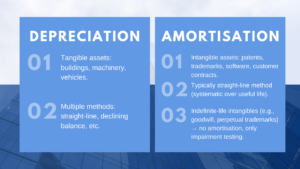
Intangible assets having finite useful lives, such as patents, licensed technology, customer relationship assets acquired during a business combination, and software, are amortised over their useful economic lives and are only tested against impairment when there is an indication that the asset may be impaired. They are known as triggers or indicators, which are evaluated at every balance sheet date and contain both external factors (such as deterioration in the market or adverse regulatory developments) and internal factors (such as indicators of technical obsolescence or much worse-than-expected performance). Once a trigger has been detected a full recoverable amount analysis should be conducted.
Intangible assets (where there is no foreseeable limit to their economic benefit) having indefinite useful lives, mostly goodwill arising on business combinations, but also brand names and trademarks, are not amortised under IFRS. Rather, they have to undergo how to carry out annual impairment testing of indefinite-lived intangible assets, a compulsory test that has to be carried out on all reporting periods, although it may or may not have identified any particular indicators of impairment. One of the most important compliance requirements in the accounting of intangible assets is this annual obligation, and is in many cases, the subject of audit scrutiny, regulatory review, and management challenge. The key intangible asset types, their classification of life, how to amortise the intangible asset, and the test trigger are summarised in Table 1 below.
| Intangible Asset Type | Life Classification | Amortisation? | Impairment Test Trigger |
|---|---|---|---|
| Patents | Finite (legal term) | Yes – more than useful life. | Indicator-based (when impairment indicators are available) |
| Trademarks | May be definite or indefinite. | Only if finite-lived | Annual (unless indefinite); indicator-based (unless finite) |
| Goodwill | Indefinite | No (IFRS) / Yes (US GAAP pre-2014) | Mandatory under IFRS 3 / IAS 36: Annual impairment test mandatory. |
| Brand Names | Indefinite (unless there is a contractual restriction) | No | IAS 36: Annual compulsory test. |
| Customer Relationships | Finite (contract/churn-based) | Yes – longer than anticipated customer life. | Indicator-based only |
| Software / Technology IP | Finite (technology cycle) | Yes – typically 3–7 years | Indicator-based; fast obsolescence is a frequent cause. |
Table 1: IAS 36 Intangible Asset Classification and Impairment Testing Triggers
Step-by-Step Impairment Testing Process for Intangible Assets Under IAS 36
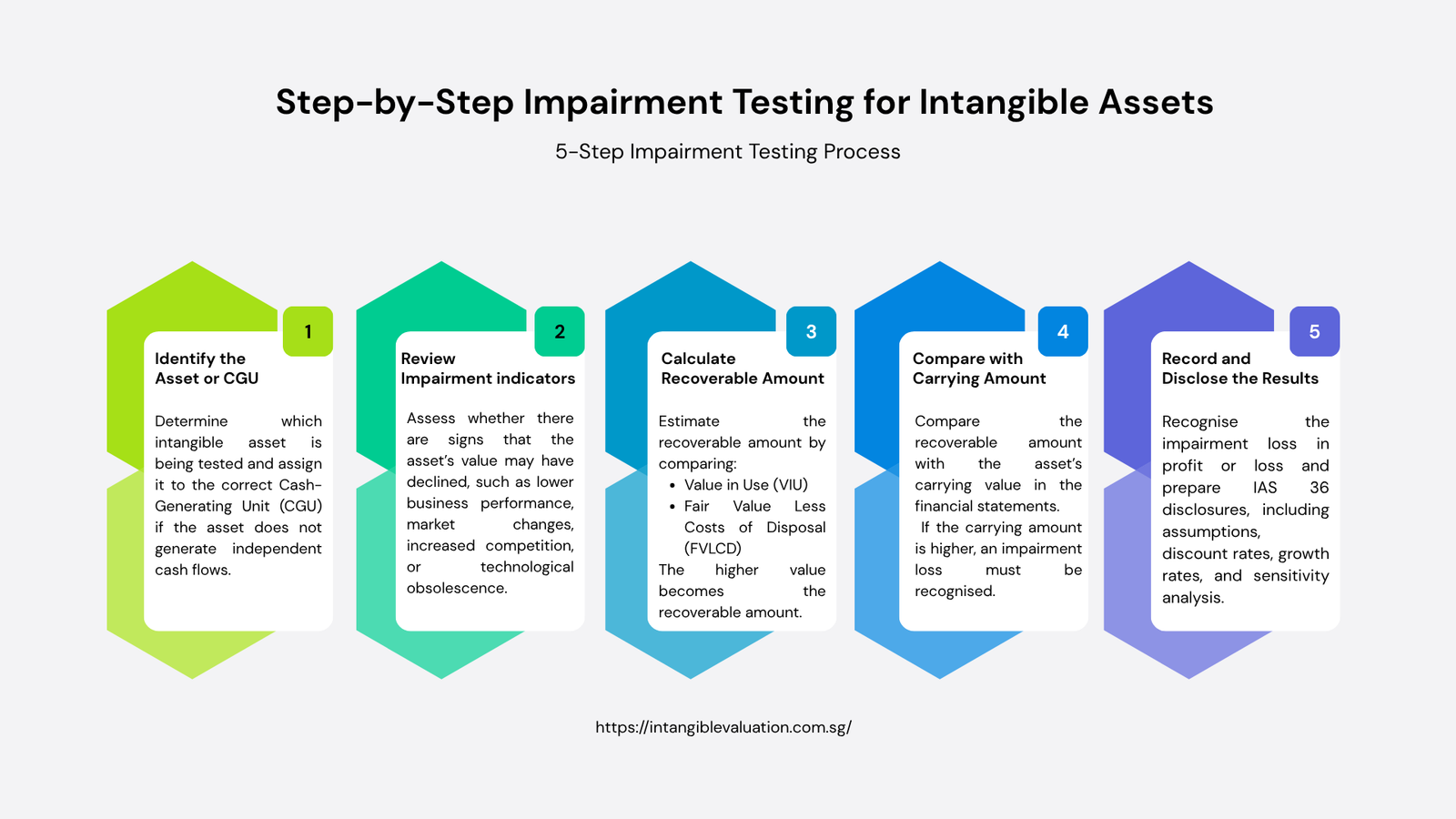
The process of calculating the recoverable amount in a test of impairment of intangible assets is structured into five steps of detailed workflow under IAS 36. All steps are based on the preceding step, and any errors or shortcuts in any of the steps will affect the integrity of the overall assessment.
Step 1: Determine the Asset and assign it to a Cash-generating Unit (CGU).
The beginning point of any impairment test would be the identification of the specific intangible asset to be tested and whether it would generate cash flows separately or not, in isolation, but only in combination with other assets. Those intangible assets which produce independent cash flows, such as a licenced technology platform which generates stand-alone royalty income, can be tested separately. In most instances, however, intangible assets do not have independent cash flows of their own; instead, they are a part of the earnings of a larger business operation. Under these circumstances, the asset should be allocated to the smallest group of assets that produces cash inflows that are largely independent of those of other groups: it is the Cash-Generating Unit, or CGU. Goodwill and indefinite-lived brand assets acquired as a part of business combinations must be allocated to CGUs in a manner that reflects the level at which the management monitors and manages goodwill to serve internal purposes, though there is an upper limit of operating segment defined under IFRS 8. One of the most highly judgemental decisions in the whole impairment testing process, and which has such a drastic effect, is the proper identification and definition of the CGU.
Step 2: Determine Indicators of Impairment (or Annual Test Confirms Applies)
In the case of intangible assets that do not have an indefinite life, Step 2 would include a systematic review of the impairment indicators in IAS 36 at each of the balance sheet dates. And this is the opening to the test: in case there are no indicators on the current period, there is no need to further assess the current period. Paragraph 12 of IAS 36 gives the list of indicators that need to be reviewed; this is not an exhaustive list. In the case of indefinite-lived assets, it is a formal confirmation that the annual mandatory test is applicable- there is no exemption, no indicators, no test. The audit should record the indicator assessment in the work papers and should be signed by a responsible financial officer or audit committee, since regulators and auditors are increasingly questioning whether the indicator review was done with due diligence. The main indicator categories of IAS 36 are mapped onto their practical implications of how to perform annual impairment testing of indefinite-lived intangible assets and of finite-lived assets alike in Table 2 below.
| Indicator Category | Examples | Practical Implication for Testing |
|---|---|---|
| External Sources | Massive contraction of the market, negative change in regulations, intensified competition, and rise in discount rates, and technological upheaval. | Test the full recoverable amount even when not in the annual cycle when testing indefinite assets. |
| Internal Sources | Indications of obsolescence, restructuring initiatives, physical destruction, and unexpected performance as compared to the budget. | Reevaluate CGU allocation; revise cash flow projections, and then implement the recoverable amount model. |
| Financial Metrics | Market capitalisation is less than the carrying amount of net assets, decreasing EBITDA margins, and covenant pressure. | Carrying value of intangible to market indicators can squeeze headroom quickly. |
Table 2: Key IAS 36 Impairment Indicators and Recoverable Amount Assessment Factors
Step 3: Determine the Amount Recoverable.
This is the most technically challenging part of the detailed workflow of calculating the amount of recoverable assets in the assessment of impairment of intangible assets. The recoverable amount of an asset or CGU is the higher of its Fair Value Less Costs of Disposal (FVLCD) and its Value in Use (VIU) under IAS 36. The standard provides that the higher of the two values be used since rational economic behaviour would choose whichever one will result in a higher payoff.
Value in Use is determined as the present value of the future cash flows that are likely to be generated by the asset or CGU and the risks associated with the asset. The cash flow forecasts that are used in the VIU calculation should be based on reasonable and supportable assumptions, use the latest approved management budgets or forecasts, cover at most five years unless otherwise justifiable, and apply a long-term growth rate for periods beyond the explicit forecast period that is not to exceed the long-run growth rate of the market in which the entity operates. Use of a discount rate should be a pre-tax rate that is in compliance with a pre-tax cash flow; many practitioners commit the error of using a post-tax WACC, which is not in compliance with a pre-tax cash flow except when adjusted separately.
Fair Value Less Costs of Disposal is the fair valuation of the asset in a fair and orderly transaction between the buyers and sellers of the asset, less the direct costs of disposal. FVLCD is calculated with the input of the IFRS 13 fair value hierarchy, which prefers observable inputs (Level 1 or Level 2 inputs) within the hierarchy over unobservable inputs (Level 3). In practice, in most cases of intangible assets and goodwill-bearing CGUs, market evidence of the same is limited, and FVLCD is estimated based on a valuation technique (such as a market multiple approach to EBITDA or revenue) that reflects the assumptions of market participants about the same, rather than those of the entity. The greater of the two values is considered to be the recoverable amount when both VIU and FVLCD are calculated.
Step 4: Accounting of Recoverable Amount to Carrying Amount and Recognise any loss.
Having the recoverable amount established, Step 4 makes a comparison between the recoverable amount and the carrying amount of the asset or CGU. The balance sheet balance after accumulated amortisation (where the asset has a finite life) and any previously recognised impairment losses is called the carrying amount. In the event that the recoverable amount is greater than the carrying amount, then there will be no impairment, and the test will be complete, although the headroom (the excess recoverable amount as compared to carrying amount) should be disclosed, as it would provide context to the sensitivity analysis to which the disclosure should be accompanied. In the case where the carrying amount is greater than the amount recoverable, then an impairment loss exists and must be recognised. In the case of an individual asset, the impairment loss is a reduction in the carrying amount of the asset directly and is recognised in the profit or loss in the period. In a CGU that includes goodwill, the impairment loss shall first of all be allocated to reduce the carrying amount of the goodwill allocated to the CGU and any remaining loss shall then be allocated to the other assets of the unit on a pro-rata basis based on their carrying amounts subject to the limitation that no individual asset shall be written down below the highest of its own fair value less costs of disposal, its value in use and zero.
Step 5: Prepare Disclosures and Document the Test.
The last step in step-by-step impairment testing of intangible assets using the IFRS is the final step of ensuring that the test is well documented and that the necessary disclosures are prepared to be included in the financial statements. The paragraphs 126-137 of IAS 36 provide a lot of disclosure requirements in case of impairment losses as well as in assets and CGUs where the recoverable amount has been decided based on value in use or the fair value less the cost of disposal. In the case of CGUs that include goodwill or any other intangible that has indefinite life, the disclosures must include the key assumptions used in the calculation of the recoverable amount, the discount rate to be applied, the period of the cash flows projections, the rate of growth used after the specific period of projections, and a sensitivity analysis of the amount by which a key assumption would need to change to have the carrying amount equal the recoverable amount. Auditors, analysts and regulators heavily scrutinise such disclosures and one of the most typical areas of regulatory comment on financial statements.
Annual Impairment Testing Workflow
Identify Asset & CGU Allocate intangible assets to the cash-generating unit | ▶ | Screen for Indicators IAS 36 external & internal triggers | ▶ | Calculate Recoverable Amount Higher of VIU and FVLCD | ▶ | Compare to Carrying Amount Impairment if RA < CA | ▶ | Recognise & Disclose P&L charge; IAS 36 disclosures |
Process Flow 1: Annual IAS 36 Impairment Testing Workflow for Intangible Assets and CGUs
Recoverable Amount Calculation: Step-by-Step
Build Cash Flow Forecasts Management budget, max 5 years, growth rate | ▶ | Determine Discount Rate Pre-tax WACC; CGU-specific risk | ▶ | Calculate VIU PV of future cash flows incl. terminal value | ▶ | Estimate FVLCD Market data or exit multiple; less disposal costs | ▶ | Select Higher Value Recoverable Amount = max(VIU, FVLCD) |
Process Flow 2: Step-by-Step Recoverable Amount Calculation Under IAS 36
Real-World IAS 36 Impairment Testing Cases and Key Financial Reporting Lessons
The best way to learn how to do annual impairment testing of indefinite-lived intangible assets in practice is by looking at how big impairment charges have been in practice in real corporate situations, and what the failure of accounting and disclosure in those situations has taught.
The largest impairment charge in the history of the IFRS at the time occurred in February 2019, with Kraft Heinz, the US consumer goods company, recording a US$15.4 billion impairment charge in February 2019. The charge was mainly associated with the impairment of goodwill and indefinite-lived intangible assets, including the carrying values of a few iconic brand names, which had been acquired in the 2015 merger of Kraft and Heinz. Analysts and investors who had seen the company’s prior-year disclosures observed that the headroom of its CGU-level impairment tests had been dwindling over the years, but the disclosed sensitivity tests had not sufficiently communicated the nearness of the tests to breach. The practical implication of both of the above is twofold: first, the sensitivity analysis disclosure required by IAS 36 is not a sham; second, where the headroom is very narrow, the annual review of material assumptions must be conducted with an increased rigour, since small changes in growth rates or discount rates can often turn an impairment test result of a pass into a fail.
The second teaching case is that, between 2012 and 2018, Vodafone booked goodwill impairment in its European subsidiaries of tens of billions of pounds, for a total of tens of billions of pounds. The impairments resulted primarily from the combination of structural market deterioration – the growing competition from mobile operators – regulatory pressure on the roaming charges, and the deflationary effect of OTT services on voice and messaging revenues, as well as pressures on discount rates – the market risk premiums – for these services were reviewed upwards. The key which practitioners were interested in with Vodafone was the volume and depth of the charges – impairment was not a single correction but an extended multi-period recognition of value that had been built up in goodwill when the acquisitions were made at prices that were not fully realised over the years. Such a trend indicates a fundamental issue in impairment testing: the accumulation of impairment charges over a period of time, instead of being recognised at the time when value is lost.
An example of the third case, which is in the pharmaceutical sector, is that the detailed workflow to calculate the recoverable amount in intangible asset assessments must be directly related to the operational reality. When a phase III clinical trial of an in-process research and development asset of a major pharmaceutical company fails, then the in-process research and development asset carried on the balance sheet at a significant amount, representing the expected economic benefits of a successful drug approval, must be immediately impaired to zero, because the probability-weighted future cash flows attributable to such asset fall to insignificance on the trial failure. Companies that had continued to have strong, scenario-based recoverable amount models of pipeline assets found it easy to move to impairment recognition. Those who had been using optimistic single point forecasts were forced to re-establish the basis of prior carrying values on the basis of significant audit and regulatory review. The moral of the story is that the models of impairment testing should be designed in such a way that outcomes of scenarios are accommodated in the design of the model rather than being retrofitted when unfortunate events take place.
Common Challenges in IAS 36 Impairment Testing and How to Overcome Them
The practical implementation of step-by-step impairment testing on intangible assets under the IFRS continues to present a group of issues that transcend beyond the technical provisions of IAS 36 and involve a lot of professional judgement in getting over those issues.
The most widespread problem can be the management bias in forecasting cash flow. The assumptions of the revenue growth and the operating margin trend, which are used to calculate Value in Use, are based on management forecasts themselves. The management is, of course, interested in minimal or absent impairment, as an expense will decrease the reported earnings and can convey a signal of operational weakness to the market. The finance professionals and auditors should be ready to question the forecasts that seem to be inconsistent with the recent actual performance, industry trends, or market data. One of the best practices is to compare the key assumptions as used in the current year impairment test to those used in the prior test and to the actual results achieved since the prior test. Where the past-year assumptions have throughout tended to present an exaggeration of the actual performance, this is a serious pointer that the current-year forecasts should be put under a greater level of scrutiny.
Determination of the discount rate is a second point of regular challenge. IAS 36 recommends a pre-tax discount rate, but most financial practitioners are more at ease with post-tax calculations of WACC. To calculate a post-tax rate as the equivalent of a pre-tax rate requires an iterative process that takes into account the tax shield on the cash flows, and the result is generally sensitive to the assumptions about the tax rate that applies, and the tax position of the CGU. In the case of cross-border CGUs, which operate in more than one tax jurisdiction, the determination of the discount rate is even more complicated. Also, as interest rates skyrocket, as in the case of global interest rates in 2022 and 2023, the corresponding increase in the discount rate leads to a decrease in the present value of future cash flows and can mechanically cause impairment even where the underlying operational performance of the business has not declined. It is in the interest of Finance professionals to comprehend this interest rate sensitivity to be well placed to predict impairment risk and proactively communicate the same to audit committees and boards.
The third recurrent challenge, especially to businesses undergoing restructuring or acquiring new entities or even changing their internal reporting structure, is CGU definition and stability. The requirements of the IAS 36 are that the definitions of CGUs must be consistent across periods unless a change is justified. In practice, management periodically makes changes in the definition of CGUs, which can sometimes mask impairment. When there is a change in the definition of CGU, there should be a redistribution of the goodwill and intangible asset balances that are allocated to CGUs, and prior-year comparative impairment tests may have to be restated or reconciled. The finance professionals who are working on impairment assessments of businesses that have undergone material reorganisation should ensure that the changes in the definition of CGU is properly documented and that the reason behind the change is auditable.
Practical IAS 36 Impairment Testing Insights for Accounting and Finance Professionals
One of the most technically challenging and commercially significant aspects of financial reporting in the IFRS is impairment testing of intangible assets. Their combination is highly prized by employers in audit, advisory, corporate finance, and financial reporting functions, as the combination to test impairment step by step of intangible assets is required in the IFRS.
The most practical point of departure for the rest of the professionals in their careers is to read IAS 36 in full and formulate a working understanding of how the requirements of IAS 36 are translated into the real-world testing processes. A task that develops authentic technical fluency is much more efficient than textbook learning alone in building genuine technical fluency. The practical exposure gained by seeking out opportunities to participate in impairment reviews, whether as a member of an audit team, as a valuation support role, or as an internal finance role, gives the practical exposure that solidifies conceptual knowledge into professional competence.
To more senior practitioners, the most valuable lesson of the cases and challenges discussed in this article is that the quality of impairment testing can ultimately be a matter of the quality of the assumptions and judgements that are embedded in it, and not the sophistication of the model. The detailed workflow on calculating recoverable amount in intangible asset testing is well-established; whether the cash flow forecasts are realistic, whether the discount rate is well-calibrated, whether the CGU definition is a commercially defensible definition, and whether the sensitivity analysis is telling the financial statement reader something genuinely useful about the margin of safety. The characteristic of an impairment testing professional who actually creates value is the development of professional credibility and the technical command necessary to challenge management assumptions and to defend rigorous conclusions under pressure. and the basis on which that credibility is founded is the understanding of the full depth of how to carry out annual impairment testing of indefinite-lived intangible assets.