Accredited Patent Profit Generation Models
Turning Patents Into Profit Engines: Practical Models for Monetisation
Introduction: Accredited Patent Profit Generation Models
Patents have been said to be strategic assets, yet, again, there are too many companies who possess them and do not entirely know how to turn them into streams of recurrent revenues. Although there are several monetisation options, including direct sales or direct litigation, licensing is the most scalable, predictable, and commercial-viable options the business in any industry. When the product life cycles are becoming shorter and the innovation spending is increasing, effective patent licensing is changing the intangible IP to a stable source of profits. This paper explores the operational framework, models and business implications of licensing as a strategy of monetisation, and provides an instance as to how organisations can convert their patents into profitable financial resources.
1. Licensing: As a Monetisation Framework.
Through licensing the patent holder is able to transfer the rights to a second party with the provision of financial incentive but the ownership of the underlying IP will remain with the patent owner. It is flexible and scalable, thus it is applicable to technology companies, manufacturing organizations, medical innovators, and start-ups that require cash flow and do not want to dilute equity.
1.1 The reasons why licensing is the best of the monetisation models.
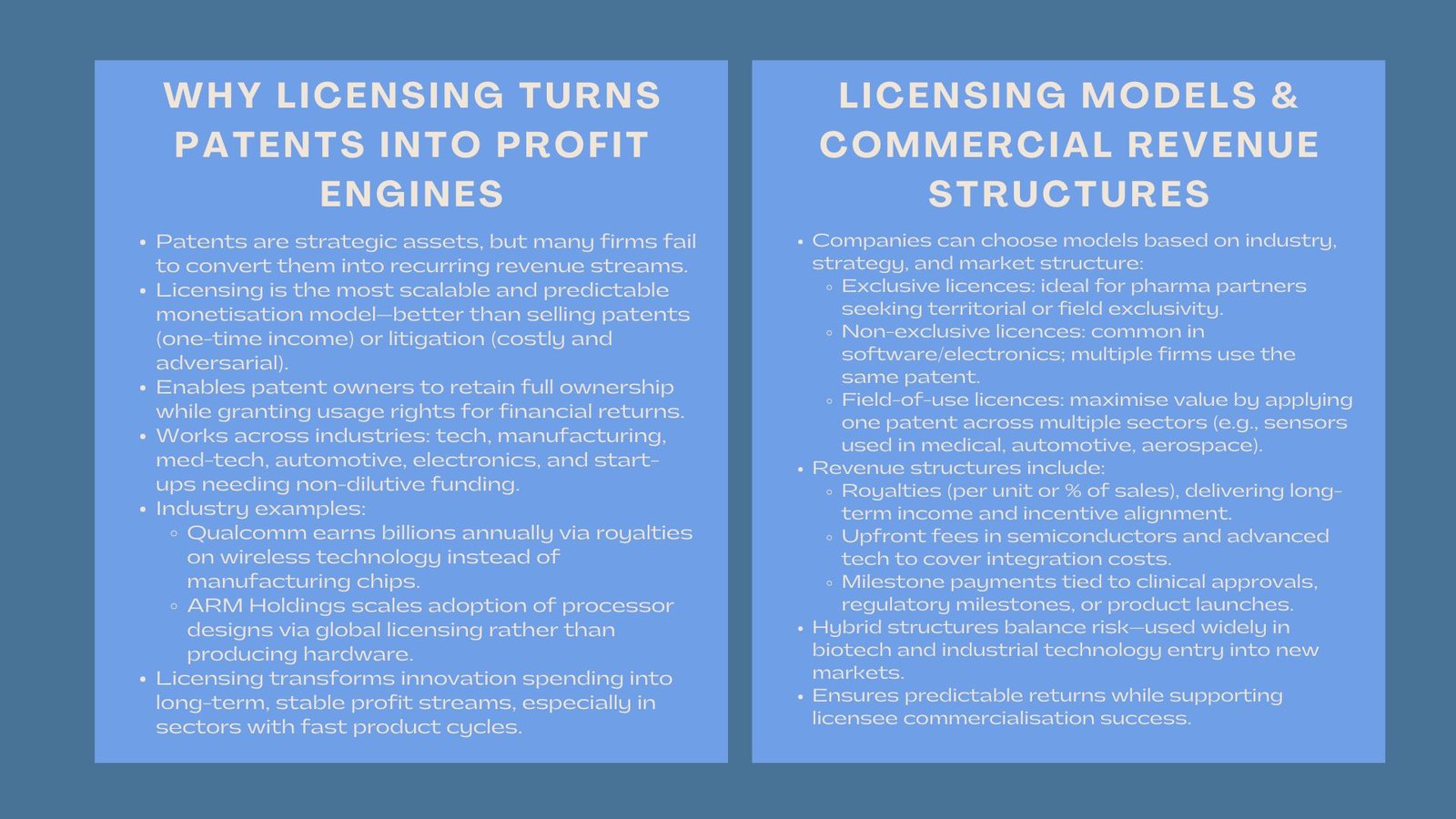
As opposed to the sale of patents, which only provides a one-time earnings, licensing allows to generate continued cash during a period of time. Such firms like Qualcomm, Dolby Laboratories and ARM Holdings reveal the power of licensing as a business concept. Qualcomm is not a chip manufacturing company but it collects billions of dollars every year as royalties when it grants its key wireless communication patents to the makers of the devices that operate on its technology globally. This approach will help the company to remain immune to volatility in hardware markets and guarantee a steady stream of IP-related revenue.
Licensing is also free of the litigious adversarial nature and expenses. The monetisation obtained through enforcement may be profitable but is random and image-oriented. Licensing, in turn, promotes collaborative business relations and partnerships in the long term.
1.2 Types of Licensing Models
The licensing systems differ according to the strategic objectives. Exclusive licences offer the benefit of one party having the rights to all aspects within a specific field or region and would work best in the case of pharmaceuticals searching distribution partners. Non-exclusive licences are licences that can be shared by many other companies using the same technology, as it is the case in software and electronics. Field-of-use licensing lets licensors profit on the same patent in other sectors, like commercialising a single sensor patent on its own in automotive, medical device and aerospace. Both strategies enable companies to customise monetisation strategies to market structures and competitive positioning.
2. Revenue Structures and Commercial Terms.
The structuring of payment terms to provide a licensing arrangement must be done in such a way that it offers a balanced risk and reward to both the parties.
2.1 One-Time Payments versus Recurring Royalties.
Royalties – calculated either as a percentage of sales or per unit fees are the most common one. This scheme fits incentives: licensees are using proven innovation and licensors are getting repeated payments. As an example, medical device innovators will often license patented surgical devices to large manufactures and receive per unit royalty as the device becomes widely used globally. This helps in the viewability of revenues in the long term.
There are industries, particularly semiconductors, where big advance payments are favored to compensate the integration fee of patented architecture in design. Such initial charges can be combined with milestone-based remuneration that is based on regulatory approvals or product launches.
2.2 Risk Management Hybrid Structure.
Hybrid licensing models are a combination of an upfront payment, milestone payments, and royalties, with equal risk sharing. The hybrid structure is common in biotech firms that are collaborating with large pharmaceutical firms. As an illustration, a start-up company that has created a therapeutic compound would pay a start-up fee to access the technology, extra sums when the clinical trial stages are met, and royalty when the innovation is commercialised.
Hybrid deals are also used by manufacturers who are venturing into new international markets. A manufacturer of a patented industrial coating could come to an agreement by paying less royalties but requiring a minimum annual payment by a overseas distributor. This gives a solid predictable income in the event that market penetration is delayed.
3. Licensing of Patents: Strategic Factors to be taken into account.
A licensing program only works when it is in line with the overall corporate strategy.
3.1 Enhancing Market Stance by Selective licensing.
Licensing may have offensive and defensive purposes. On the offensive, it allows technology to ramp to levels of production greater than in house. This is the experience of ARM Holdings which licenses processor architecture to other parts of the world to hasten the pace of adoption without making hardware. Cross-licensing creates a defense against the risk of litigation in such areas as automotive and telecommunications, where overlapping patents occur regularly.
Selective licensing is also useful in ensuring that companies grow in to neighboring industries without over expenditure of capital. Considering the above, an example of a material science company that is licensed to produce high-strength composite can license it to energy companies, automotive companies, and sports equipment companies to diversify the revenue streams and remain in the fundamental business.
3.2 The Portfolio Assessment Role.
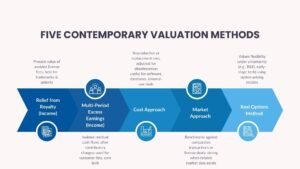
The companies need to assess the strength of the patents, commercial relevance and market preparedness before getting the license. A robust patent valuation for technology commercialisation strategy assesses revenue potential, identifies likely licensees, and benchmarks competing solutions. In the absence of such evaluation, companies will be subject to the danger of licensing assets that must be held strategically.
Dormant patents still have market value that is also identified during the portfolio reviews. IBM has a history of proactively identifying patents that were not being leveraged properly and turning them into major licensing business, as they help it transition to software and services.
4. Developing Successful Licensing Alliances.
The very nature of licensing is relationship-based. Close relationships define the achievement of the revenue potential.
4.1 Licensing of High-Value Licensees.
The most preferred licensee will include those who have strong scaling capability and compelling commercial requirement. In a case scenario, a cleakech-based company that owns a patented water-purification membrane might not have an infrastructure in manufacturing worldwide. The ability to license to a multinational environmental solutions provider would allow international deployment to be implemented quickly and provide royalties.
To find such partners, market mapping, competitor analysis, and technology fit may be needed to identify them. Most companies use technology transfer offices, accelerators, and industry networks to contact extremely compatible licensee candidates.
4.2 Long-Term Management
Relationship management is structured in a way that it leads to success in the long term. In quality implementation, licensors have to monitor compliance, check royalty reports and provide technical assistance. An example is Dolby which has partner support teams that make sure consistency of the thousands of licenced audio products.
Many firms adopt a strategic IP licensing management framework that coordinates legal, financial, and operational oversight. Periodic performance evaluations, joint development, and open data sharing can be used in order to avoid conflicts and reinforce teamwork.
Conclusion
Licensing is the most economically viable and operationally adaptable way of converting patents into profit engines. Licensing can be used to produce recurring revenues, faster market acceptance and competitive positioning when it is planned to be effective, with good portfolio evaluation, properly crafted commercial terms and long-term management of partners. Firms who have learned how to license convert intellectual property as a passive legal safeguard into a high performance business asset. With the world industries ever growing faster in innovations than ever before, the individuals who are clever in cashing in on their patents will be at the centre of value-generation and competitive growth.