Certified Brand Valuation Strategy Training
How Strong Brands Become Cash Cows: Pricing Power, Loyalty & Market Dominance
Introduction to Certified Brand Valuation Strategy Training in Intangible Assets
A brand is more than a name, logo or advertisement message. On the top tier, a brand is turned into an economic engine, the one that has the power to produce greater prices, loyalty, and long-term domination on the market. What businesses are often doing is basing their competitive advantage on features of their products or operational efficiency but the real competitive advantage can be seen when a brand has a premium price because people trust it, like it, and can associate themselves with it.
As high the brand equity, it transforms pricing decisions developed as defensive responses into revenue generating strategies. The paper analyzes the ways of how strong brands can use their equity in monetising their pricing power and how such mechanisms can be reflected in the terms of high-profitability, long-term sustainability, and market leadership.
1. Economic Value of Pricing Power based on Brands.
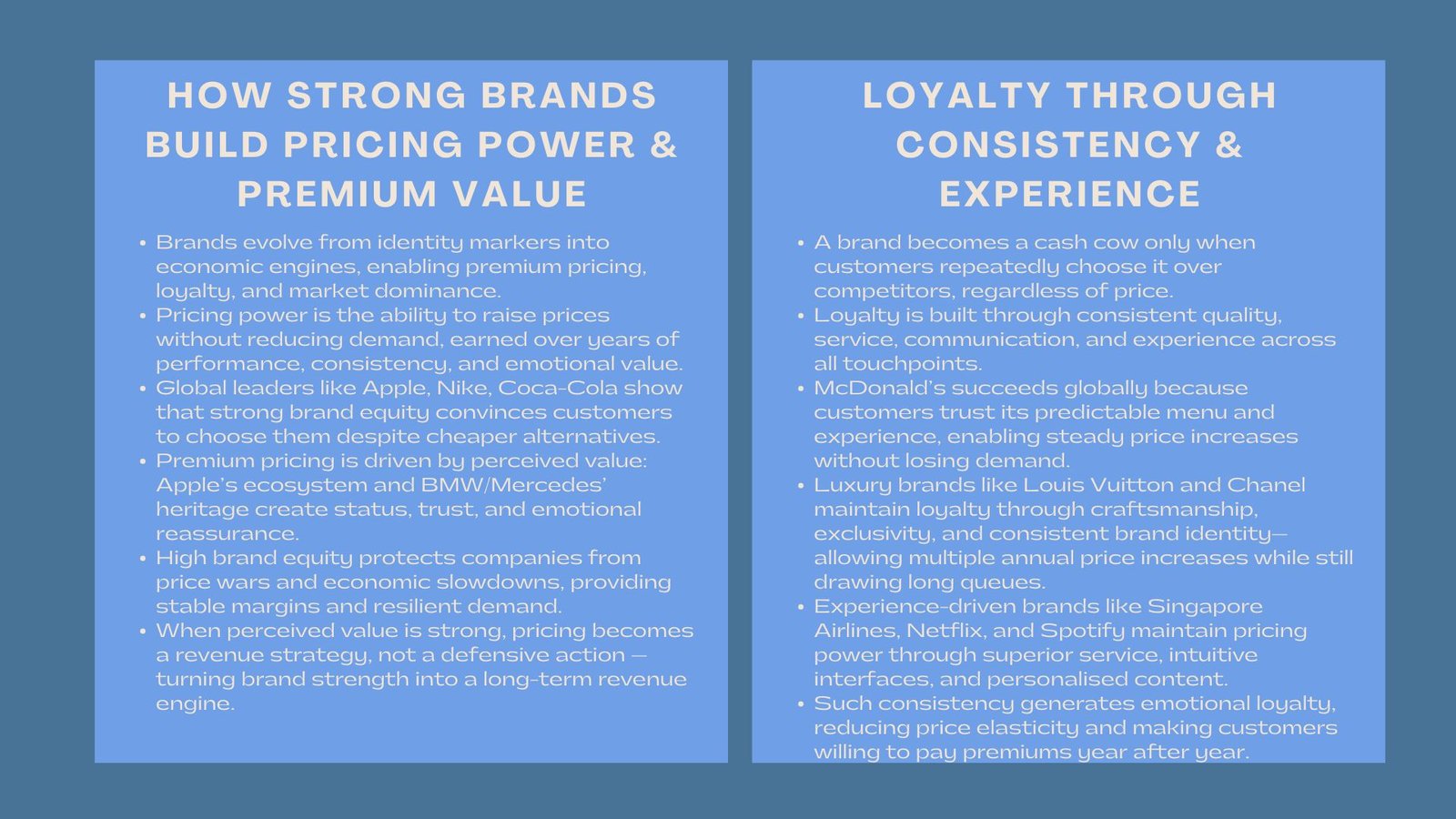
Pricing power is the capacity of a business to increase the prices without a commensurate decrease in demand. It does not come fast, it is earned processes through performance, perceived value and emotional attachment. Apple, Nike, and Coca-Cola are global brands that have proven that when they have strong brands, customers will continually make the same choice despite the existence of cheaper options.
1.1 Perceived Value and Premium Pricing
Good brands establish rings of perceived value that counterbalance high prices. An example is the iPhone by Apple, which is in a saturated smart phone market, but that still continues to sell at premium prices due to the perceived superiority of consumers with its ecosystem, design and reliability as well as status signalling. This perceived value helps the brand to escape price wars and vulnerability to economic cycles.
This trend is also evident in the automobile sector. The higher prices are not due to the performance itself but to brand stories based on engineering, heritage, and exclusivity, which brands such as BMW and Mercedes-Benz have. They symbolize the dream, and customers can easily be tempted to expand their budgets to acquire that image.
These examples show that brand equity premium monetisation strategy is one of the most reliable revenue levers across sectors.
1.2 Emotional Loyalty and Reduced Price Elasticity
Once customers associate themselves with a brand on an emotional level, their price sensitivity is lowered. That is why in many cases strong brands have inelastic demand curves, they can change the prices and increase the price with little impact on the volume. A good example is provided in Starbucks. Its drinks are also sold at a higher price compared to most local cafes but its stores all over the world are filled to capacity. Besides paying a higher price, consumers buy the drink because of the convenience, consistency, ambience and emotion tied to the brand.
In a similar manner, Tide and Pampers (under Procter and Gamble corporate ownership) continue to control the market share regardless of the generic products available at 30-40 percent lower prices. They have a long history of quality products giving their demand stickiness and repeat purchases based on their quality image.
2. Winning Loyalty by being Consistent and Experienced.
A brand can only be a cash cow when customers keep on utilizing it over the competitors. The basis of that loyalty is consistency, consistency in the quality of the product, customer service, communication and experience in general.
2.1 Providing Coherence at the Touchpoints.
Trust is achieved through consistent brand experiences and pricing power is achieved through trust. One of the reasons why McDonalds is a success worldwide is that the consumers are fully aware of what they will get regardless of the location they visit. It is this predictability that allows the company to increase the price on a gradual basis across the regions without diminishing the foot traffic. The disciplined operation and homogeneous experience of the brand make the brand seem reliable to its customers who are ready to spend on this brand perception.
Louis Vuitton and Chanel are examples of high-end fashion brands that have achieved brand loyalty by being consistent in their craftsmanship and exclusivity. These brands maintain long queues outside their stores notwithstanding the frequent changes in prices (sometimes more than once in a year). Customers have confidence in their constant quality and will attach emotion to owning the brand, which allows them to raise prices annually without any resistance.
2.2 Customer Experience to create a loyal customer.
Contemporary consumers demand more than practical advantages they demand emotional, non-resistant experiences. Experience based brands tend to develop loyalty to an extent that customers are ready to pay a premium price.
Consider the case of Singapore Airlines. It has created loyalty by providing superior service, safety documents and brand recognition. This will help the airline to maintain a higher ticket price than most of the regional airlines and also record good load factors. People do not view the purchase as just an air travel but as something special to pay more.
The subscription economy is also formed based on experience-based loyalty. Netflix and Spotify continue to have pricing power because they have a simple user interface, customised content, and convenient accessibility. Most users are willing to continue being subscribers notwithstanding the increases in prices since the value proposition exceeds the incremental cost.
3. Brand Positioning and differentiation towards a dominant position in the market.
Pricing strategies are seldom used to gain market dominance. Rather it is because of the long term brand positioning strategies, which render the brand the default brand in its category.
3.1 Preferential Position in the Consumer Mind.
Once a brand is a mental default, it is very hard to be knocked out of the place by the rivals. The case of Google is a good example: although the product is free, a brand name makes it possible to monetise it immensely with the help of advertising and business services. On the same note, Visa and Mastercard are very dominant in terms of acceptance in the global market when it comes to payments since they are accepted as a standard, universal, and reliable payment.
Indirect pricing power is also developed by default status. Indicatively, the Intels inside campaign made Intel the brand preferred processor over the decades, and it was able to charge higher margins than most of its rivals. As the default option, the consumers and the manufacturers would each be willing to pay a higher price to obtain the perceived reliability.
3.2 Differentiation which cannot be easily copied by the competitors.
This necessitates brand differentiation that is either hard or slow to copy in order to achieve sustainable differentiation. The example of Patagonia is a strong example: the development of an environmental mission, activism, and transparency is a brand identity that is hard to copy by competitors. Such distinction enables Patagonia to sell its products higher than market averages and still retain considerable demand by value-oriented consumers.
Red Bull is different in fast-moving consumer goods. It has pricing power that is unparalleled with generic energy drinks since it has extreme sports associations, unique marketing, and a continuous positioning. The brand personality has been deeply entrenched to the extent that Red Bull commands a high price even in times when cheaper substitutes are offering the same or similar functional advantage.
Such examples show how a brand positioning for long-term pricing resilience strategy becomes a long-term revenue moat.
4. Transforming Brand Strength into a Cash Cow Model.
Powerful brands have a compounding impact on profits. The moat is deepened every year with consistent branding, customer experience excellence, and innovation as well as leadership in the market. With time, the most significant invisible asset of the brand is the pricing power.
4.1 Strategic Outcome Margin Expansion.
Therefore, strong brands are more likely to have higher gross margins because they are able to sell at high prices and still sell at high volumes. Investors tend to evaluate brand strength indirectly through the stability of the margins, percentage of repeat purchases, and economic cycle pricing behaviour. During inflationary times, brands that have strong pricing powers will perform better than the competitors since they are able to transfer the costs easier.
4.2 Long-Term preeminence by Brand Equity investment.
Efforts to build a brand whether on a product through R&D, marketing, design, experience etc. compound over time. This compound effect turns good brands to cash-generating giants that can move into other related markets. The development of Nike into an apparel, accessories, and digital experience indicates the ability of the pricing power and loyalty to create new avenues of monetisation.
Conclusion
The reason why strong brands are cash cows is not by mere aggressive pricing but because of deep and long lasting relationship with the consumers. The perceived value, emotional loyalty, exceptional experiences, and the high differentiation that cannot be easily adopted by the competitors creates brand-driven pricing power.
When such aspects are fostered by a company over time, it can have the luxury of increasing prices with impunity, increasing customer loyalty and attaining a long lasting market dominance. It is in a more competitive and saturated global marketplace that those brands who invest strategically in the equity, consistency, and experience are going to remain the ones who shine – and turn that advantage into greater long-term profitability.