Certified Copyright Digital Asset Training
Transforming Copyrights Into Scalable Digital Assets
Introduction to Certified Copyright Digital Asset Training
Copyrights have always been regarded as fixed protection, legal measures that protect the works of creativity and prohibit unauthorized exploitation. However, in the digital economy, copyrights are not defensive mechanisms; they are highly effective business assets that can be copied, distributed, bundled, and monetised in large scale. With the increasing rate of digital consumption in entertainment, education, media and technology, the capacity to transform the copyrighted material into scalable digital items is no longer a choice that content creators have. It is an innate spur of recurrent revenue, access to the global markets, and future development. This paper discusses the role of digital licensing structures as the driver behind copyrighted content to grow in an efficient and profitable manner.
1. The Transfer of the Secured Works to Digital Content.
The customary approach to copyright monetisation was dependent on the physical distribution, that is, books, CDs, DVDs, printed materials, or live shows. This was because these formats restricted duplication, geographic scope and relied on linear supply chains. Digital technology has changed this paradigm whereby copyrighted work can now be duplicated instantly and distributed all over the world at very minimal cost.
1.1 Why Scale is Unlocked by Digital licensing.
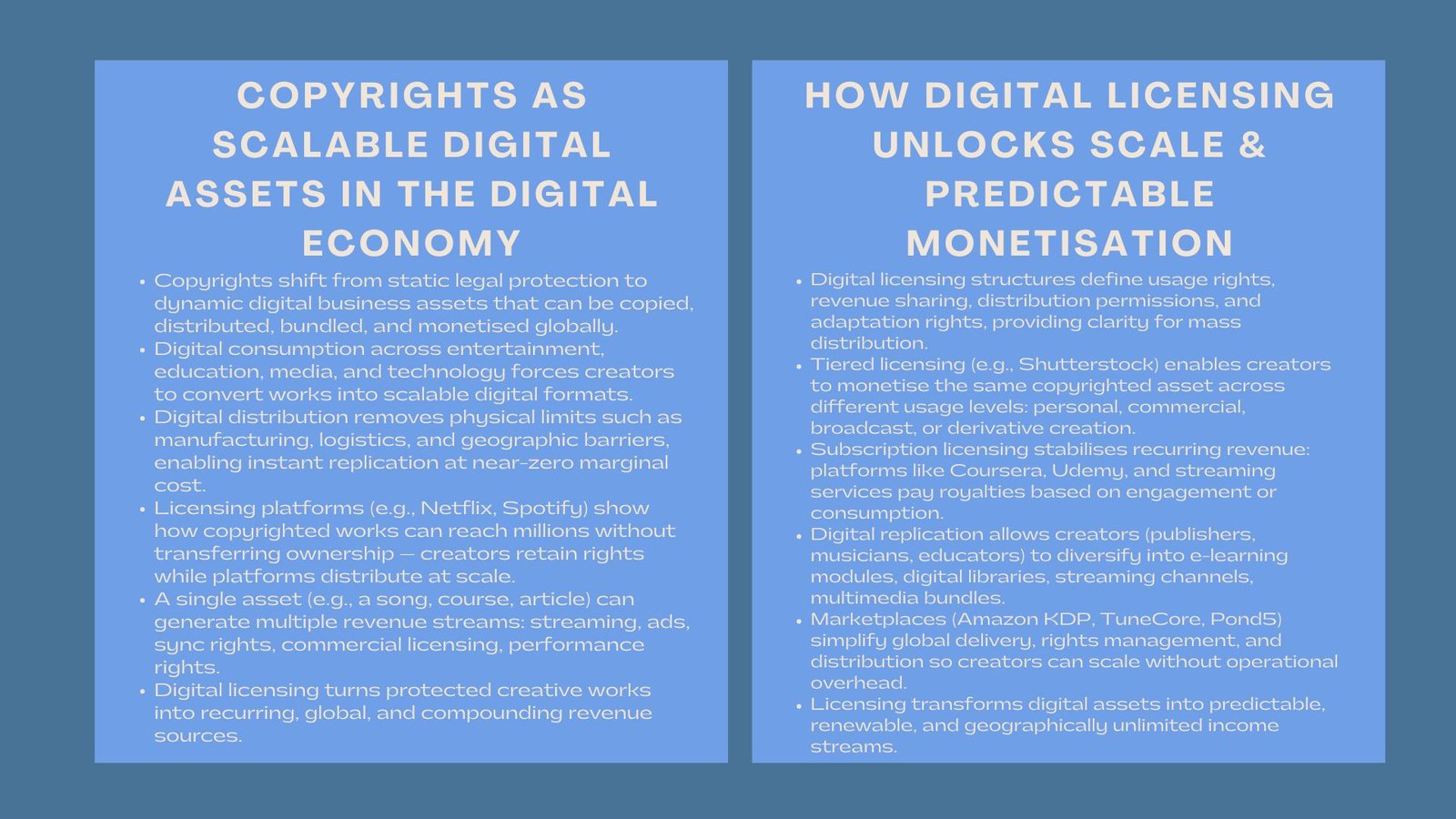
Digital licensing transforms an original piece of work under copyright law into a replicable asset which can be utilized, used and resold in various platforms and markets without owning it. Spotify and Netflix are good examples of this change: the whole business model is based on the accumulation of licensed copyrighted content and providing it to millions of subscribers. The ownership remains with the creators they only allow the platform to distribute the content to the masses without reducing the value of the original content.
This is an indication that licensing is capable of multiplying a single copyrighted work, like a movie or a song, into several monetisation streams. One song can be monetized in streaming, advertisement, sync licence, performance rights and commercial use. Through a digital copyright monetisation model for creative industries, creators achieve reach and scalability that physical formats could never provide.
1.2 The Economics of Digital Replication
The key feature of the digital copyright content is that the reproduction of the content can occur at almost no cost. Scalability is not bound by the capacity of manufacture or distribution as in the case of physical goods. This enables creators, publishers and brands to develop multiplier revenue by diversifying into e-learning, digital libraries, streaming services and content markets.
As an illustration, one of the examples is educational publishers who previously depended on the sale of textbooks, now license the digital modules, interactive evaluation and multimedia lessons via subscription websites. Each licensed version is nearly free to copy, but will be able to bring in a recurring profit and broader usage.
2. Developing Successful Digital Licensing Systems.
Digital licensing decides the access, usage and monetisation of the copyrighted works. It forms the foundation of scalability since it organizes the rights, permissions and revenue structures that support mass distribution.
2.1 Structuring and Access Control of Rights.
The licensing systems should explicitly clarify rights of usage: commercial, personal, broadcast, distribution, adaptation or derivation creation. It is software, online courses, stock pictures and digital music which are based on a hierarchy of rights.
Such websites as Shutterstock, to name a few, provide simple licences of online usage and more advantageous licences of a significant commercial use. They are both based on the same image that is under copyright but the tiered licensing increases earning opportunities.
There are parallel structures in the case of digital authors. An e-book can be licensed to end-users, to libraries to be digitally lent out, or to publishers to be further adapted into a book as an audiobook or as an educational summary. Both levels increase the area of revenues without creating new content.
2.2 Predictability Subscription-Based licensing.
Most copyright holders are now adopting subscription license to stabilize revenue. In other digital course providers such as Coursera or Udemy, the creators of the course are given recurring royalties on learner engagement. Independent artists receive streaming royalties that give them monthly payments. Digital content syndication services involve regular fees to access to licensed articles, research reports or media assets.
This subscription business is successful because the users would appreciate ongoing access and the creators would appreciate the anticipated cash flows and compounding revenue growth.
Companies that implement a royalty-based content licensing subscription strategy often find that it strengthens retention and makes revenue more forecastable.
3. Content Diversification and Multi-Platform Monetisation
The copyrighted information can be repackaged and marketed on various platforms due to the licensing structures, which increase its commercial longevity.
3.1. Repurposing the Copyrighted Content.
One piece of copyrighted work may be converted into many digital assets. Think of the way a popular novel can be changed:
- It turns into an audio book which is a licensed book to audio medium.
- It is filmed into a screen play that is licensed to a streaming service.
- It is internationalized and licensed.
- Individual passages are under educational license.
- The rights of the characters can be licensed to merchandise or interactive experiences.
This is a multi platform growth facilitated through licensed structure which transforms a single creative asset into a sustainable revenue generator.
3.2 Distribution via the Digital Marketplaces.
Scalability is increased in marketplaces. Amazon Kindle Direct Publishing is used by authors to license e-books around the world. TuneCore distributes to dozens of streaming platforms at the same time and musicians distribute their music through it. The creators of stock footage sell their videos to websites such as Pond5, which gives them a worldwide and timeless distribution.
The marketplace takes care of the delivery, management of rights, and international reach and creators are concerned with developing a portfolio. This eco-system guarantees that copyrighted materials receive exposure among the audiences and markets, which in most cases need not involve extra operational input.
4. Scalable copyright Monetisation Technological Enablers.
Protecting, tracking and monetising of digital assets revolves around technology. Large-scale licensing would hardly be possible without strong systems.
4.1 Digital Rights Management (DRM)
DRM systems are used to authenticate users, access control, and unauthorised copying. They are instrumental in such industries as film, software, and online education. The streaming services can implement DRM at several levels such as device, account, and network to safeguard the integrity of licensing. With this technology, international distribution can be done without losing the intellectual property.
4.2 Automation of metadata, tracking and royalty.
Metadata engineering enables platforms to recognise, follow, and monetise the digital assets in an appropriate manner. Metadata helps music streaming services to identify ownership, issue royalty, and implement licensing regulations. On the same note, publishers use structured metadata to syndicate articles, label copyrighted snippets and administer licensing deals.
Royalties are being paid because automated royalty mechanisms ensure the creators receive the payouts in a timely manner and transparently. These technologies minimize administrative workload and sustain massive licensing processes in thousands of assets and millions of users.
5, Sustainability By Partnering With the Licensee.
Scalability is not only technology-driven but also great working relationships with distributors, aggregators, and platforms.
5.1 Global Reach Strategic Alliances.
Authors of copyrights tend to form partnerships with distribution channels in an attempt to internationalize. Cinema studios have an alliance with streaming-media, universities with digital libraries, research publishing houses with international scholarly databases.
The exposure is increased by these partnerships without any ownership through licensing agreements. This is not to lose control but to achieve maximum utilisation.
5.2 Creation of Ecosystems, Not Products.
The best owners of copyright revolve around ecosystems. This is the way Disney is doing. The theme parks, merchandise, soundtracks, and streaming content are products of its films, all under a strategy of licensing. Every asset enhances itself, an ecosystem of self-reinforcing digital, that is massively scalable.
Conclusion
Creativity is insufficient to turn the copyright into a digital object that is scalable, it takes systematic licensing platforms, technological infrastructure, multiple platform distribution and strategic alliances. Through adopting digital licensing practices, creators and organisations turn secured works into repeatable, monetisable and globally scalable revenue streams. It is only in a digitalized world where digital consumption keeps gaining pace, where the next growth, innovation, and creation of economic value depends on the art of transforming copyrighted content into licensed digital assets.