Certified Trade Secrets Monetisation Training
Converting Know-How and Trade Secrets Into High-Margin Advisory Solutions
Introduction to Certified Trade Secrets Monetisation Training
The most valuable resources within a firm in the knowledge-based economy of the present-day are in many ways intangible: proprietary techniques, specialised expertise and trade secrets that are acquired over years of finding unique operational, technical and strategic solutions. Although these resources lead to internal competitive advantage, most companies do not realise that the very intellectual capital could be converted to profitable, scaled, and defensible advisory services. When managed properly, specialised know-how may turn into recurrent revenue designs, elite advisory solutions, or even industry-acceptable standards that would massively boost brand equity.
This paper addresses a single facet namely how firms can commercialise internal know-how through the development of high-margin advisory services which can be standardised and packaged and sold across markets.
1. Making Proprietary Know-How into Market-Ready Advisory Produces.
1.1 Recognising Expertise that has Commercial Potential.
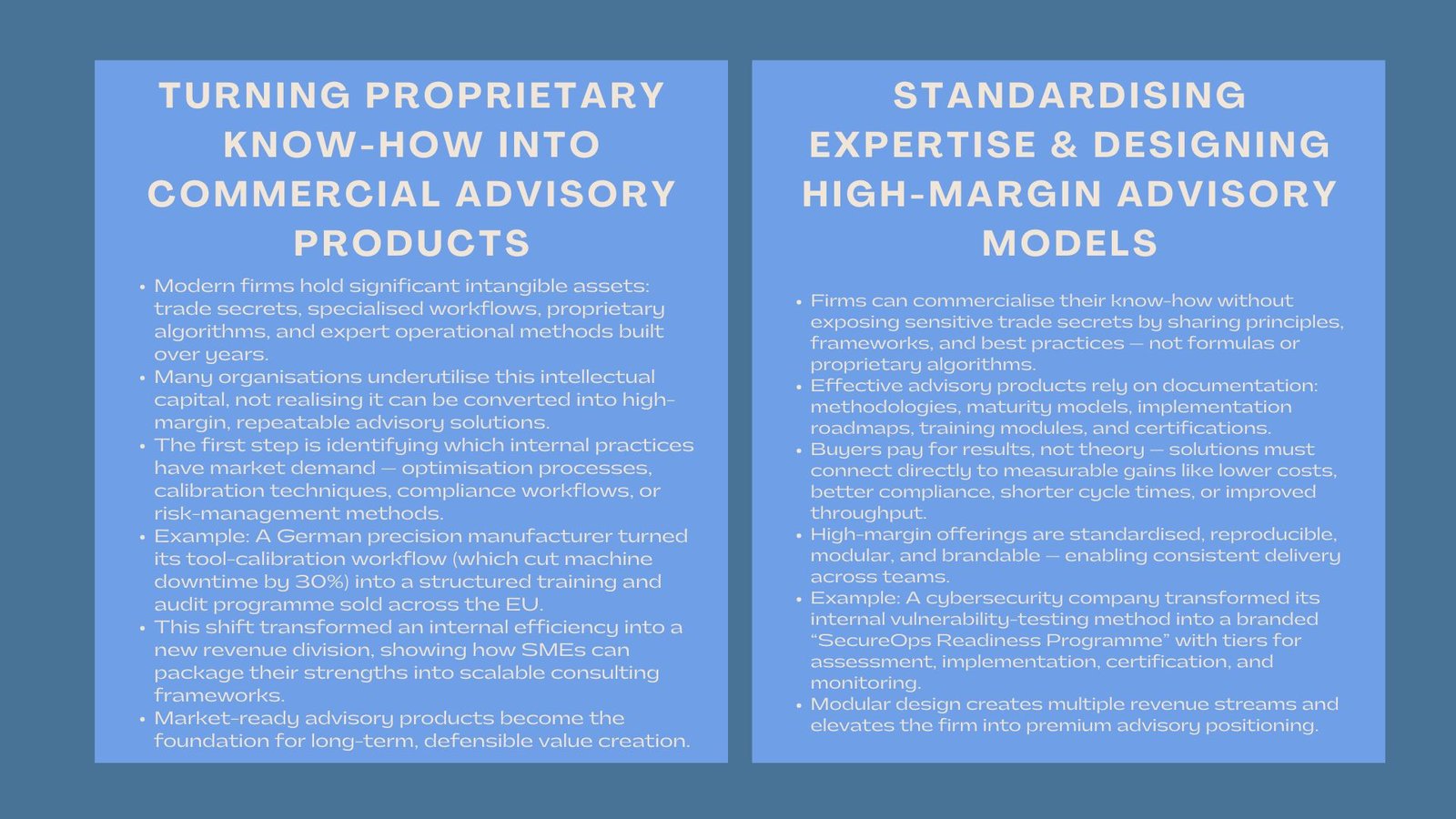
The initial process of transforming trade secrets into advisory solutions is to identify which internal practices are demanded in the market. Companies tend to undervalue their internal processes, be it a specific production process, a risk-management algorithm, a quality-control process, or a procurement process optimisation process.
As an example, one of the mid-sized companies in Germany specializing in precision manufacturing came up with its own tool-calibration workflow, which in turn shortened the operating time of machines by almost 30 percent. Over time, the peers in the industry would want to know how the company was able to stay so reliable. Building up on the commercial potential, this knowledge was then packaged, by the firm into an organised training and audit programme, which would later be sold to other manufacturers in the EU. What started as an operating business strength became an all new business division.
This type of transformation forms the foundation of high-margin consulting frameworks for SMEs, particularly in industries where operational efficiency provides both immediate and measurable value.
1.2 Standardising Internal Expertise Without Revealing the “Secret Sauce”
Commercialisation of know-how is something most companies are afraid to undertake because it would expose trade secrets. This is tackled by designing advisory products effectively which will extract principles and not proprietary details.
A logistics firm that has created a particular route-optimisation formula might not share its precise formula. Rather, it is able to commercialise the principles of best practices, governance models, diagnostic instruments, and performance standards. This way, the business will not only be guarding its intellectual property but will be able to rake in money under its expertise and brand name.
Effective companies record their in-house practices in:
- repeatable methodologies,
- implementation roadmaps,
- assessments or maturity models,
- training and certification programmes.
These allow the clients to get access to proven structures without having to see the sensitive elements that form the competitive advantage of the firm.
2. Know-How It Products
2.1 The Solutions Designing Around Measurable Impact.
Companies do not buy advice but they buy results. To achieve success with know-how monetisation, the advisory solutions have to be directly connected to the quantifiable outcomes in the form of enhanced throughput, lower cost, greater regulatory compliance, or reduced project cycles.
A food maker in the Southeast of Asia created a high-value advisory services around its own supply-chain traceability system that it had developed to meet export requirements. The advisory product consisted of compliance gap analysis, process re-engineering workshops and readiness audits. Since the value proposition was measurable in terms of faster certification and reduced rejection rates, the company could charge high prices.
2.2 Developing Repeatable, High-Margin Structures of Offerings.
The most lucrative advisory products are those which are:
- Standardised, which would guarantee consistency of delivery.
- Reproducible, so that teams can grow, without having to reinvent every engagement.
- Modular, making it possible to add onsell, like audits, implementation and continued support.
- Brandable, unlike generic consulting services.
As an example, the internal vulnerability-testing approach was transformed into a branded programme called a “SecureOps Readiness Programme” by a cybersecurity solutions provider. The company had levels of tiering, which include Assessment, Implementation, Certification and Continuous Monitoring. Such modularity resulted in the development of several revenue streams and the ability of the firm to position itself among the high-end advisory providers.
3. Scalable Advisory Engines: Constructing Digital and Knowledge Platforms.
3.1 Converting Know-How of Advisory into Digital Deliverables.
Digital transformation has broadened the possibilities of companies to monetise the know-how without consulting hours which are labour intensive. The expertise may be transformed into:
- online diagnostic tools,
- subs based benchmarking systems,
- automated assessments,
- workflow templates,
- digital training academies.
One Australian chemical processing company created a digital safety compliance dashboard using its internal audit checklists and incident-prevention models. The sale of access to this platform on a subscription basis with a yearly subscription model provided the company with a recurring source of income and minimized the client reliance on manual consulting engagement approaches.
This type of innovation is central to organisations building scalable knowledge-based advisory services, enabling them to reach global clients without expanding personnel proportionally.
3.2 Leveraging Data From Advisory Projects to Reinforce the Competitive Moat
Business models that are advisory-based create valuable intelligence. This data forms a great competitive advantage when combined and anonymised. Firms can identify:
- universal inefficiencies in industries,
- performance benchmarks,
- emerging client pain points,
- new product opportunity patterns.
According to several advisory engagements conducted by a renewable-energy engineering firm, small-scale solar farms had problems with maintenance scheduling. With this understanding, it created a predictive-maintenance- advisory device utilizing its asset-management expertise. Since then dozens of operators have taken the tool, and this has strengthened the leadership role of the firm.
The loopback of data as a part of the consulting engagements to product development increases the sophistication and identifiability of the advisory engine with time.
4. Adopting a Commercial Model that helps to maintain a high level of margin.
4.1 Changing One-Off Engagements to Multi-Year Advisory Relationships.
It is one of the largest risks of advisory monetisation to get stuck in project-based and unpredictable income. In response, companies move to long-term alliances supported by subscription components like:
- annual audits,
- compliance updates,
- performance monitoring,
- irregular optimisation visits.
A healthcare analytics firm has turned its hospital workflow evaluation service into an annual subscription that featured periodic optimisation evaluation and ongoing data tracking. The outcome was predictable revenue and increased lifetime value of the client.
4.2 Creating Brand Authority in order to charge a premium price.
Brand authority is a factor of high-margin advisory offering. Firms enhance their credibility by:
- reports in the publishing industry,
- offering certifications,
- speaking at conferences,
- collaborating with trade associations,
- presenting case-studies and results audits.
A firm in the automation of industries that described a customary “Lean Robotics Diagnostic Framework” increased demand quickly when it demonstrated its research discoveries in global manufacturing meetings. The brand authority established a price premium which expanded margins of the advisory engagements by a significant margin.
Conclusion
Trade secrets and specialised know-how are not internal strengths of operation but strong commercial resources who are yet to be realised. Through systematic discovery of expertise to the value of the market, its standardisation into advisory models, use of technology to scale provision, and creating long-term relationships with clients, organisations can convert internal knowledge into high-revenue streams. Where intangible assets determine competitive advantage, the process of transforming know-how into solutions realised by the market cannot be an option. It is a business necessity to firms that want to differentiate, diversify their revenues, and develop sustainable leadership within their industries.