How Publishing Rights Turn Into Royalty Cash Flow Machines
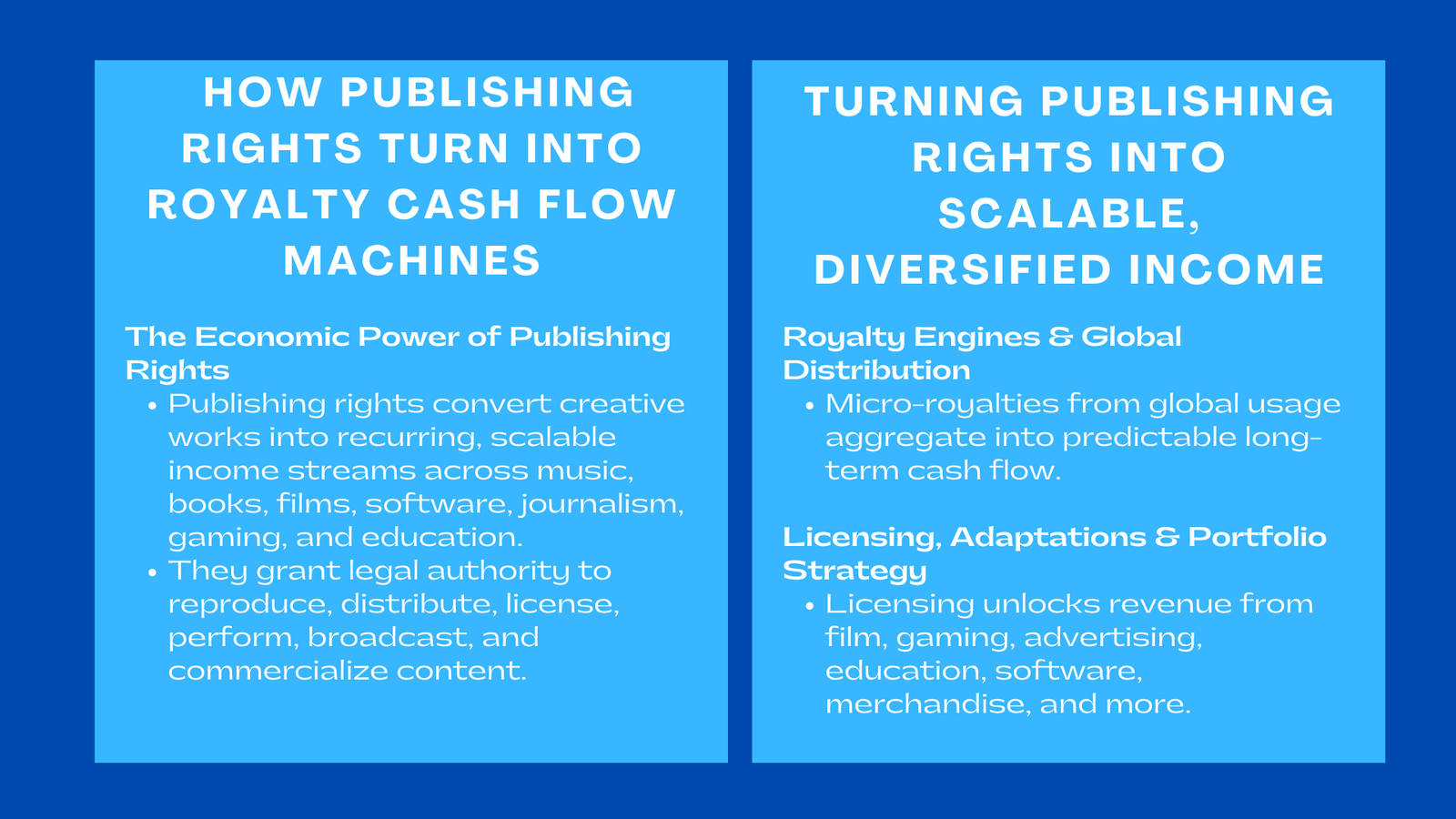
In the modern intellectual property landscape, publishing rights have emerged as one of the most reliable and scalable forms of cash flow generation. Whether in music, books, films, software, journalism, gaming, or educational content, publishing rights operate as contractual engines that convert creative works into recurring revenue streams. These rights represent the legal authority to reproduce, distribute, perform, broadcast, license, and commercialize creative output. Once secured and properly structured, they transform intangible creativity into predictable, long-term financial returns. Unlike physical assets that depreciate, publishing rights often appreciate in value as cultural influence grows, making them uniquely powerful economic tools.
The digital revolution drastically altered how creative content is consumed. Streaming platforms, global distribution networks, social media ecosystems, and digital marketplaces have created unprecedented demand for creative works. While creators frequently focus on producing content, the true financial power lies in owning the rights behind that content. Publishing how publishing rights generate long-term royalty income rights allow creators, investors, and companies to profit every time a work is used, referenced, performed, or monetized. This shift from creation to ownership marks a fundamental transformation in the economics of creativity. Those who control the rights—not necessarily those who create the content—are the ones who reap the greatest financial rewards.
Understanding Publishing Rights as Revenue-Producing Intellectual Property
The Commercial Engine Embedded in Copyright Ownership
Publishing rights sit at the core of copyright law, granting exclusive control over how a work is used commercially. These rights include reproduction rights, distribution rights, synchronization rights, public performance rights, mechanical rights, translation rights, adaptation rights, and digital licensing rights. Each of these rights represents a separate revenue channel that can operate simultaneously, allowing a single piece of IP to generate income multiple times across different platforms, industries, and geographic markets. This multi-layered monetisation structure is what transforms publishing rights into perpetual cash-flow assets, a concept increasingly recognised even in fields like SaaS revenue transformation training Singapore where content ownership and monetisation models are similarly pivotal.
Why Publishing Rights Behave Like Compounding Financial Instruments
Unlike traditional business assets that require constant input to generate output, publishing rights can continue earning even when the creator is not actively involved. Every use of the work—whether streamed, downloaded, printed, performed, licensed, quoted, sampled, or remixed—generates royalties. Over time, as a work becomes more culturally embedded, its royalty flow can compound. Older works often experience revenue resurgence when rediscovered by new audiences, repurposed for new media, or used in new commercial contexts. This compounding effect makes publishing rights comparable to dividend-paying financial instruments that grow in value as the IP matures.
How Publishing Rights Become Cash Flow Engines
Royalty Structures That Generate Continuous Income
Publishing rights translate creative output into royalties through a structured system of licensing and usage fees. These royalties can arise from physical sales, digital streaming, broadcasting, licensing agreements, public performances, educational distributions, and commercial placements. Each royalty payment represents a micro-transaction that accumulates over time. When a work reaches a global audience or becomes a cultural staple, these micro-transactions aggregate into a steady, sometimes substantial income stream. This reliable flow of royalties explains why investors increasingly acquire publishing catalogs as long-term cash-flow assets.
The Network Effect of Global Distribution
Digital distribution platforms have dramatically broadened the reach and income potential of publishing rights. A song can be streamed in hundreds of countries, a book can be downloaded worldwide within seconds, and a digital article can circulate across multiple platforms instantly. This global reach creates exponential monetisation opportunities. Each additional market introduces new consumers, new licensing partners, and new royalty structures. As distribution networks expand, the IP owner benefits from wider markets without needing additional production costs. This ability to scale without physical limitations is what turns publishing rights into powerful global assets.
Monetising Publishing Rights Through Licensing and Commercial Agreements
Licensing as the Core Monetisation Strategy
Licensing allows the IP owner to grant others permission to use the creative work in exchange for payment. These licenses can take many forms, including one-time fees, ongoing royalty payments, profit-sharing agreements, or hybrid structures. Licensing enables content owners to penetrate industries they would not otherwise reach—advertising, film, gaming, education, branding, merchandise, and software. Each licensing agreement adds a new revenue stream to the publishing rights portfolio, allowing the asset to generate income through multiple channels simultaneously.
Synchronization Deals and High-Value Media Placements
One of the most profitable aspects of publishing monetisation is synchronization licensing—the use of music, writing, or creative works in films, commercials, video games, streaming series, corporate content, and online advertising. Synchronization deals often command substantial upfront fees along with backend royalties. When a creative work is placed in a culturally influential medium, its exposure multiplies, leading to increased sales, streams, or derivative uses. These placements can dramatically elevate the revenue-generating potential of the underlying publishing rights.
Expanding Cash Flow Through Derivative Works and Adaptations
Turning One Creative Work Into Multiple Revenue-Producing Variations
Publishing rights allow owners to license derivative works, including translations, adaptations, remixes, updates, spin-offs, and reformatted versions. A single book can become a film, a merchandise line, a podcast series, an audiobook, a documentary, or a digital interactive experience. A song can become a remix, a dance challenge, a sample, a cover, or a soundtrack theme. Each derivative version generates its own royalties while reinforcing the visibility and value of the original work. This multiplicative effect turns publishing rights into networks of interconnected income streams.
Cultural Longevity Through Continuous Reinvention
Creative works often regain popularity due to cultural moments, viral trends, new adaptations, or seasonal relevance. Each resurgence brings new revenue opportunities. This cyclical nature of cultural consumption allows publishing rights to generate income for decades, sometimes centuries. Intellectual property can outlive its creator, becoming multigenerational wealth assets passed down through estates or sold to investment funds. The long-tail potential of publishing rights creates ongoing financial relevance even when the original market moment has passed.
Building Publishing Portfolios for Scalable and Diversified Income
Aggregating Multiple Works Into Royalty-Portfolios
Investors, publishers, and companies often acquire multiple publishing rights to build diversified royalty portfolios. These portfolios smooth income volatility, increase overall cash flow stability, and enhance long-term asset appreciation. A well-curated catalog can generate predictable revenue across genres, cultures, and markets. When one work experiences a surge in popularity, it lifts the value of the entire portfolio. This portfolio model mirrors investment strategies used in finance, turning creative rights into structured income-generating assets.
Using Data Analytics to Maximize IP Profitability
Modern publishing monetisation relies heavily on data—stream counts, engagement metrics, geo-targeted demand, licensing trends, demographic consumption, and cross-platform analytics. Data-driven insights allow publishers to identify where a work is gaining traction, which markets to target, which licenses to pursue, and how to maximize exposure. The ability to analyze usage patterns transforms publishing rights from static legal assets into dynamic financial instruments with predictable behavior patterns.
Leveraging Legal and Structural Protections to Maximize Value
Strengthening the Commercial Power of Publishing Rights Through Enforcement
Strict enforcement of publishing rights is essential for preserving their value. Unauthorized use, piracy, and infringement dilute revenue potential and weaken the IP’s commercial impact. Companies and publishers use legal enforcement, digital tracking tools, and anti-piracy technologies to protect their assets. Strong enforcement increases investor confidence, enhances licensing leverage, and reinforces the exclusivity that underpins monetisation.
Using Contract Structuring to Secure Long-Term Royalty Streams
Well-structured publishing contracts determine how royalties flow across decades. These contracts define ownership splits, licensing rights, territorial scope, duration, revenue percentages, and derivative use permissions. Properly negotiated contracts ensure that the rights owner maintains both creative control and financial benefit. Contracts that allow perpetual royalty rights or renewable licensing clauses transform publishing rights into stable cash flow machines with predictable long-term returns.
Why Publishing Rights Are Attracting Investors and Private Equity Funds
The Institutionalization of Creative IP as an Asset Class
Private equity firms, hedge funds, and institutional investors have entered the IP marketplace, acquiring large publishing catalogs for significant sums. These investors view publishing rights as attractive due to their low correlation with traditional markets, consistent cash flow, and long-term appreciation potential. Publishing catalogs behave like corporate bonds or annuity streams—predictable, measurable, and relatively stable. As institutional investment grows, the financial market’s recognition of publishing rights as a legitimate asset class continues to strengthen.
The Growing Demand for Rights-Backed Financial Products
Publishing rights are now used as collateral for loans, securitized into investment products, packaged into royalty-backed financial instruments, and incorporated into structured finance vehicles. This financialization of creative IP reflects its reliability and cash-generating potential. The more creative economies expand, the more demand increases for rights-based financial products, accelerating the monetisation of publishing rights even further.
Conclusion to How Publishing Rights Turn Into Royalty Cash Flow Machines
Publishing rights transform creativity into a predictable, scalable, and multi-dimensional income system. Their power lies in the ability to generate royalties across formats, industries, territories, and decades. They require no physical infrastructure, minimal ongoing costs, and benefit from global digital distribution. As cultural consumption becomes more international and platform-driven, publishing rights evolve into financial machines capable of producing consistent returns far into the future.
In a world where content is abundant and attention is scarce, publishing rights represent the strongest form of economic leverage available to creators and investors. They embody the shift from content intellectual property portfolios for recurring cash flow consumption to rights monetisation—marking a new era in which IP ownership becomes the foundation of long-term wealth. Those who understand how to secure, structure, and monetise publishing rights will dominate the creative economy, turning intangible ideas into enduring financial legacies.