Startups Leveraging Intangible Assets for Growth
A Practical Guide for Founders, Finance Professionals, and Early-Career Analysts
Why Startups Leveraging Intangible Assets for Growth Matters to Investors
Investors do not often go to the balance sheet when assessing a startup. Rather, they pose questions that enquire about the unknown: How defensible is your technology? Who owns the brand? So, what will it be worth to have the founding team resign tomorrow? These queries revolve around intangible resources, the patents and trade secrets, brand name, customer relations, proprietary data and human capital that will see whether a young firm has the building blocks of sustainable competitive advantage. The ability to comprehend the importance of intangible assets on the valuation of a startup and decision-making by investors is one of the most viable skills a financial expert or founder in the startup world can acquire in the current funding landscape.
The move towards business-intensive, based on intangibles, has been gaining momentum over the decades. A start-up nowadays may grow all over the world with a minimal amount of physical infrastructure, by implementing software, algorithms, and brand connections to seize markets previously worth billions of dollars of real-world investment. But to the majority of founding teams – and even the junior analysts serving them – the language and mechanics of strategy of intangible assets are dark. This article is geared to alter that.
The next couple of paragraphs unravel the five most important intangible assets of interest to investors, five strategic steps startups need to make to create and communicate their intangible value and the lessons in practice that can distinguish between startups that raise capital at high valuations and those that fail to sell their asking price. Its aim is not theory, but practical insight to professionals who desire to intelligently address the intangible aspect of startup finance.
How Intangible Assets Influence Startup Valuation and Investor Decisions
Seasoned venture capital and private equity investors have very much developed mental models on how to evaluate the quality of intangible assets, even where the assets are not reflected in the financial statements of the startup. In both the IFRS and US GAAP, internally generated intangibles, like brand, customer relationship and in-house developed software, are typically not reflected on the balance sheet. This accounting invisibility brings about a huge disparity between the book value and the economic value, and it is the same disparity where the construction of the investor theories occurs. The key principle of intangible assets is how startups can leverage them to secure investors and accrue a higher valuation by bridging that communication gap with believable evidence.
The most common four-dimension approach is the investor organising their intangible assessment around four dimensions: legal protection (is the startup actually what it claims to be?), economic durability (is this asset able to generate returns over a period?), scalability (can the value be generated with no proportional increase in costs?), and its transferability (would the asset retain value on a sale or restructuring?). A start-up capable of articulating itself to everyone in all four dimensions, including, most importantly, data, documentation, and a well-defined strategic story, is objectively more investable than one that talks about having a great brand or an innovative technology.
The investor’s point of view also varies according to the level of funding. At the seed and Series A levels, investors are mostly placing bets on the ability of the team, technological distinction, and initial indications of market fit, all intangibles. In Series B and later, the focus is on recorded and defendable intangible assets: patents registered, trademarks registered, quantifiable brand equity, and data on the lifetime value of customers that indicate the strength of relationships. Investigators and their finance teams should be aware of this evolution so as to order their intangible asset development plan in line with it.
Table 1: Intangible Asset Priorities by Funding Stage for Startup Growth
| Funding Stage | Investor Focus | Key Intangibles to Demonstrate | Common Gap |
|---|---|---|---|
| Pre-Seed / Seed | Team and concept | First mover IP, subject area knowledge, pre-emerging brand name. | None of the IP protection is present. |
| Series A | Product-market fit | Owned technology, preliminary customer information, and secrets. | Unclear ownership of IP or not written down. |
| Series B | Scalability evidence | Patents, trademarks, customer relationships, and platform information. | Intangibles which are not formalised. |
| Series C / Growth | Market leadership | Brand equity, ecosystem lock-in, licensing potential | Inadequate disclosure in order to warrant a premium. |
| Pre-IPO / Exit | Durability and defence | Complete IP portfolio, lifetime value of customers, and goodwill. | Not audited or independently valued intangibles. |
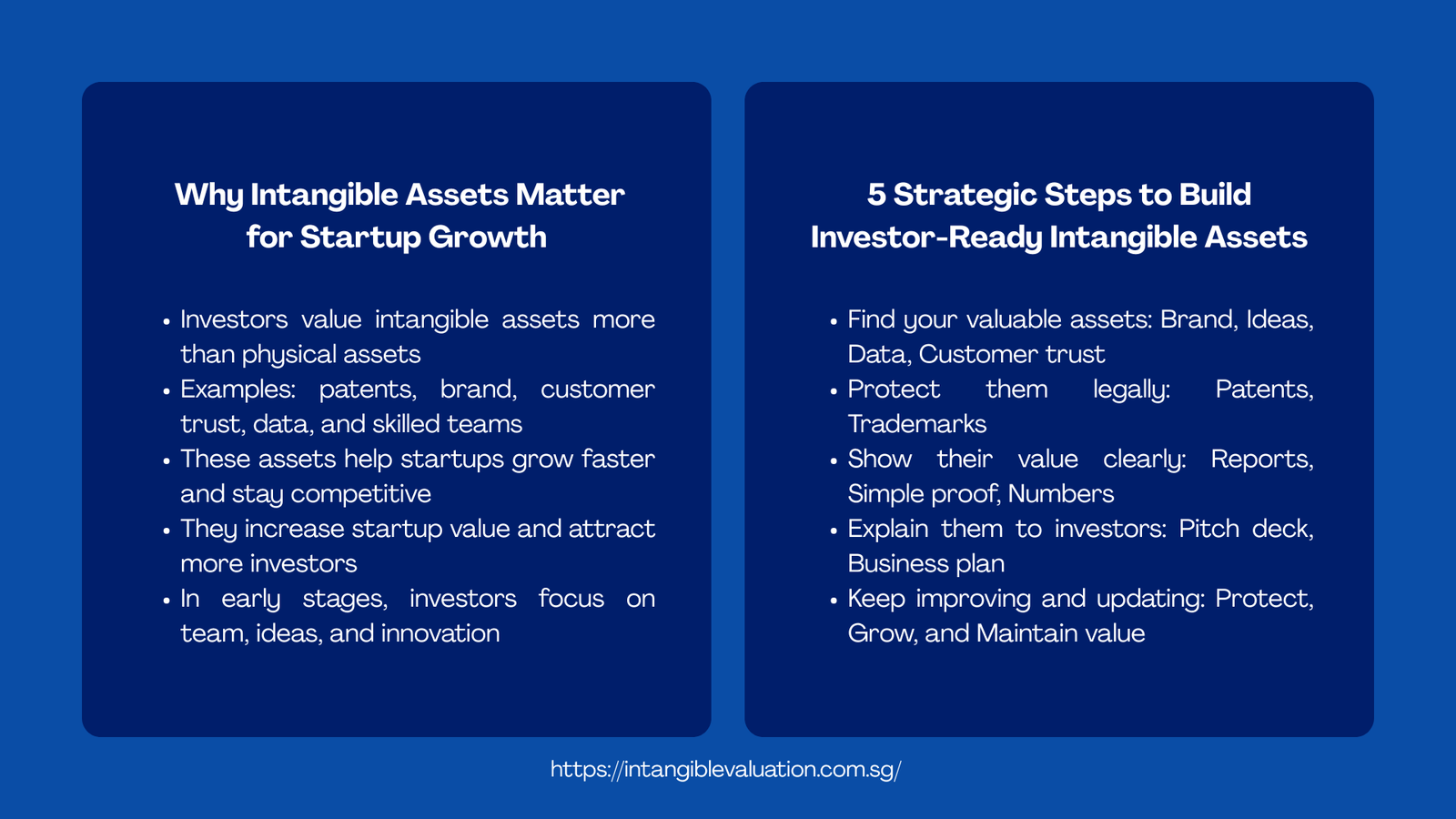
5 Strategic Steps for Startups Leveraging Intangible Assets for Growth
To take advantage of intellectual property in raising funds and valuation, there is a definite and repeatable process to follow by startups. The five steps below are the essence of an intangible asset plan that appeals to sophisticated investors and can underpin long-lasting valuation growth.
Table 2: Five Key Steps for Building Investor-Ready Intangible Assets
| Step | Action | Why It Matters to Investors |
|---|---|---|
| 1. Audit and identify | Maps all intangible assets: IP, data, brand, relationships, know-how. | The investors should be aware of what they are purchasing before they price it. |
| 2. Protect formally | Patent files, trademarks, and create trade secret procedures. | Risk is minimised by legal ownership and enhances the transparency of assets. |
| 3. Quantify and document | Use well-known valuation techniques; record assumptions. | An article with methodology is so much more believable than an article. |
| 4. Communicate strategically | Include asset story in pitch decks, data rooms and financial models. | The investors will not be able to appreciate what they cannot observe or know. |
| 5. Maintain and refresh | Filing IP updates, updating brand equity, and surveillance of competition threats. | The health of intangible assets is an indicator of discipline in management. |
Most startups do not have the strength of stage one auditing, but it is what forms the basis of everything that comes thereafter. An appropriate intangible asset audit extends past what the company has created – it inquires as to who owns it, whether the ownership of the asset is legally recorded, whether there have been any encumbrances or disputes, and whether the asset is actually differentiated as compared to what competitors provide. During due diligence of many startups, it is found out that the code has been developed by contractors without the proper IP assignment agreements or that a brand element is in use without a registered trademark. These can be fixed, although at the earliest stages.
Formal protection – especially filing a patent and registering a trademark is much more than a defensive purpose. It forms a record of innovation history, sends a message to investors that the management takes IP seriously and lets the startup engage in licensing talks to not only generate income but also prove the worth of the asset in the market. When a startup has developed an IP portfolio, however small, it will always be valued higher than its competitors since they may be equally matched in terms of their technology, but no formal protection is established.
The communication step is not taken seriously. The sophisticated investors can accept the idea of intangible value, but they need a well-developed and supported story. A start-up that can quantitatively prove the reduction in customer acquisition cost through its brand or that its proprietary algorithm creates performance benefits that are quantifiable in comparison to other options makes the work of the investor easier. This is the core of intangible asset-based startups to get investors and valuation: not by asserting a value, but by demonstrating it.
Process Flow 1:Intangible Asset Audit Process for Early-Stage Startup Funding
| Step | Action / Activity | Outcome |
|---|---|---|
| 1 | Hold the founding team and legal counsel IP inventory meeting. | Preliminary list of all created or acquired intangibles. |
| 2 | Divide into types: technology, IP, brand, data, contractual, and human capital. | Register of categorised intangible assets. |
| 3 | Check ownership: confirm employment, contractor contracts, assignment deeds. | Gap analysis confirmation of ownership. |
| 4 | Determine protection status: filed, unprotected, or trade secret. | Priority action matrix of protection. |
| 5 | Determine valuation method of individual asset classes (income, market, or cost method) | Choice of valuation methodology on each asset. |
| 6 | Prepare an investor-facing summary of the portfolio of intangible assets with important metrics. | Data room and pitch deck IP and intangibles section. |
Real-Life Examples of Startups Leveraging Intangible Assets for Growth
Venture-backed startups have a rich history of lessons that can be learned on the effects of intangible assets on the valuation of startups and decision-making by investors. Maybe, there could not be a more educational case than the experience of Airbnb, which started as a loss-making online platform that helps to find an accommodation, but because of the skills of the company management, Airbnb was listed on the stock market at a value of over USD 86 billion. It was not a set of physical assets that made Airbnb a good investment case, however: the company essentially had none of them, but an amalgamation of brand equity and network effects, inherent in its marketplace platform, a proprietary trust and review system, and relations with the community that would have been incredibly expensive to duplicate by a rival. All these are different types of intangible assets, and the management team of Airbnb explained each of them in a transparent and backed with data manner during its investor experience.
An opposite example is the cohort of so-called direct-to-consumer brands, which have raised significant venture capital in the late 2010s due to their brand storytelling and social media following. Some of these firms, including Outdoor Voices and Brandless, have been one of the most well-researched and have raised money with a valuation that suggested long-term brand differentiation, only to find that brand equity created through paid social media advertising was unsustainable and unscalable. Customers: The acquisition cost of customers increased, and the brand story promoted by advertising led to valuation crashes. The moral is that intangible assets should be based on structures; they should not be bought on an advertising basis. This is a clear depiction of how startups can use intellectual property to grow in terms of funding and valuation in a manner that would be sustainable, rather than convincing.
Another insight can be found in the enterprise software industry, where Palantir is headed toward its 2020 direct listing. The intangible value offering at Palantir was based on two building blocks: its Gotham and Foundry platforms as an asset of proprietary technology that would be guarded by trade secrets and sustained investment in the creation of technology, and its entrenched customer relationships with government and large enterprise clients. High switching costs (a fact of the extent to which its software was integrated into the operation of its clients) and continued investment in technology would have formed an intangible moat capable of evaluation by investors even in the absence of direct analogues. Palantir has had a controversial communication strategy with investors, but it has always focused on these structural intangibles, instead of more traditional financial measures.
Process Flow 2: Preparing Startup Intangible Assets for an Investment Round
| Step | Action / Activity | Outcome |
|---|---|---|
| 1 | Update intangible asset register and ensure that all ownership documentation is up-to-date. | Closed record on IP ownership with no pending controversies. |
| 2 | Valuation of intangible assets based on a recognised method, on commission or update. | A valuation report that is defensible and has its assumptions recorded. |
| 3 | Develop investor narrative: how every intangible contributes to revenue, margin or defensibility. | Pitch deck and executive summary intangible asset section. |
| 4 | Prepare data room: IP certificates, valuation report, licensing agreements. | Ready due diligence data room with documentation of intangibles. |
| 5 | Ad hoc legal advice to answer due diligence questions related to IP. | Fast, believable answers to due diligence queries of the investors. |
| 6 | Post-round: update disclosures and keep on developing intangible asset portfolio. | Continuous development of intangible assets in line with the company milestones. |
Common Challenges in Startup Intangible Asset Communication
Even startups that have intangible resources that really have value often have trouble conveying that to investors in a manner that makes sense. The initial and the most frequent obstacle is the lack of a formal value. Founders have a tendency to think, not unrealistically, that their technology or brand is worth a lot of money, but it cannot be banked. The methodology, rather than an account, is what the investors at Series A and higher will want. The startup is not properly valuing itself, requiring the investor to take its word, and it puts the full burden of proving that the startup is worth it on the due diligence of the investor. The impact of this asymmetry is nearly always to decrease the valuation that the founder gets.
The second obstacle is that of ambiguity of IP ownership. This is common in startups, mostly where initial development was performed by co-founders or contractors who did not transfer their IP to the company. When investors perform due diligence and realise that the core technology of the entity they are investing in is not completely owned by the entity, the deal is killed or the valuation is significantly discounted to indicate the legal risk. This is purely avoidable, yet it takes founders to take the issue of assigning IP as a founding-level concern and not an administrative issue.
The third issue is the temptation to overvalue intangible value. This is the other side of the problem of understatement, and it has its risks. New ventures that make exaggerated valuations about the brand, customer base or technology without substantiating it soon fall out of favor amongst seasoned investors. A brand with a USD 50 million value that can be demonstrated to lead to low customer preference in competitive testing, or a patent portfolio that can be demonstrated by an IP attorney to be designed around a small set of limited and easy to design around will not only not support a high valuation, but will in fact cause the investor to lose confidence in the judgement of the founder. Once credibility is lost in a process of funding it is very hard to regain that credibility.
Building a Long-Term Intangible Asset Strategy for Startup Growth
The most successful startups do not make the development of intangible assets an exercise of raising funds, but rather as an operational discipline. It involves integrating IP protection into the product development cycle – making sure that all major innovations are patented prior to public disclosure, trade secret practices are followed with proprietary algorithms and procedures, and brand development is thought of in the long term, as opposed to the short-term campaign results. Those companies that have inculcated this discipline at their inception are able to build up their portfolio of intangible assets in depth and credibility with each financing round, developing a compounding edge over their competitors, who then value IP as an afterthought.
Information is becoming the most intangible category of assets that make high-value startups stand out among competitors of commodities. The capacity to gather, organise, and draw proprietary insight out of data, especially on a large scale, generates informational benefit that is unbelievably hard to duplicate by others. This explains the premiums of high valuation of data network effects, which is always given by investors in marketplaces, fintech platforms, healthcare technology, and logistics. In the case of a startup in those industries, a consistent data approach, where data collection, governance, security, and competitive moat are considered, is synonymous with a patent portfolio in the hardware or pharmaceutical business. How startups can use intellectual property to raise money and increase valuation continues to evolve, with the trend of considering proprietary data infrastructure to be a defensible and communicable asset.
Another intangible that investors always put a lot of weight on (especially at the initial stages) is human capital, i.e. the expertise, domain knowledge and institutional relationships within the team. An intangible asset with a founding team that has great domain credibility, a track record in the industry and a network of customer relationships or partners is hard to price, easy to communicate. By investing in writing about and presenting the intellectual capital of their team, in terms of published work, talks, or boards of advisors, and even testimonials, startups are putting together an asset of reputation, which is intangible and supplements their formal IP portfolio.
Practical Lessons on Startups Leveraging Intangible Assets for Growth
The association between intangibles and the valuation of startups is not theoretical, but one of the most feasible and far-reaching aspects of the fundraising procedure. The effects of intangible assets on the valuation of startups and investor decision-making could be seen in all terms sheets, all due diligence, and all post-investment valuation changes. The ones that are able to consistently raise capital on terms that are conducive to them most of the time are ones that have learnt how to identify, protect, quantify and communicate their intangible assets in the same rigour that the traditional business has in regard to its physical capital.
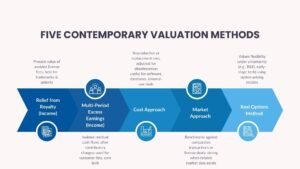
Practical implications are evident to those in the startup finance, venture advisory, or corporate development field, who will be building their careers in the area. To start with, achieve proficiency in the taxonomy of intangible assets and valuation approaches that should be used in each of them. Income approach, relief-from-royalty method and multi-period excess earnings approach are tools that recur in the context of a deal and comprehending when and how to apply is a background competency. Second, consider IP due diligence not a legal exercise, but an exercise of value discovery; the gaps and strengths you see will directly underpin your opinion of the defensibility of the startup, and its long-term value.
Third, assist the startups and organisations with which you are involved in developing their intangible asset communication capability. The founders are most often good at explaining what their product does; they are less often good at turning that into the rhetoric of sustainable competitive advantage, ownership of assets and economic payoff that investors will demand. The gap between the product story and investment thesis is where the value added by finance professionals disproportionately lies in the early-stage ecosystem. The talents needed to excel at this are at the crossroads of accounting, strategy and law: a very difficult mix, yet one that is becoming more and more sought after in the investment environment.
Last but not least, bear in mind that intangible asset strategy is a long game. The startups that get to their Series B or C with a clean IP where there is a documented valuation methodology, and where there is an internally consistent narrative connecting their intangibles to their financial performance, have nearly always been establishing that position systematically since the founding stage. The process through which startups utilise intangible resources to investors and valuation is eventually a tale of discipline, documentation and foresight, which are not only characteristic of great companies, but great finance practitioners.