Common Mistakes in Valuing Intangible Assets for Companies
A Practical Guide for Finance and Accounting Professionals
Introduction to Common Mistakes in Valuing Intangible Assets for Companies
Intangible assets in silent existence have taken centre stage in the modern enterprise value. The value that businesses have today is nearly always off-balance sheet, or even worse, misstated, to be found in software platforms and proprietary algorithms, to brand equity and customer relationships. To most organisations, the intangible assets have become the largest portion of the total enterprise value, but the methods of quantifying and reporting them are slow and prone to errors. The reality that the valuation of intangible assets of businesses is fraught with many pitfalls is no longer a speciality of experts only- it is a fundamental financial literacy skill.
The article is authored for junior and middle-level finance, accounting and business professionals dealing with financial statements, mergers and acquisitions or corporate reporting. You will be doing valuation advisory, financial analysis or corporate finance; this knowledge will enable you to find out what organisations do wrong and what can go wrong in practice in order to avoid expensive errors. The discussion is based on general frameworks, practical examples of international corporations and the guidelines according to which the reporting of intangibles is organised.
There is a lot at stake. Underestimating the worth of an intangible asset, either through overstated assumptions or premature write-offs, has a direct impact on the confidence of investors, financial ratios, taxation and pricing of deals. With the growing rivalry among businesses based on intellectual capital, brands and online infrastructure, the error margin in valuing intangible assets is becoming smaller.
Intangible Asset Valuation Challenges and Common Mistakes in Valuing Intangible Assets
Intangible assets do not have a purchase invoice, which doubles up as a fair value estimate, as is the case with a factory or a fleet of vehicles. The value of them lies in economic payoffs in the future that are uncertain in nature, the legal protection they enjoy, and the context of their application. This renders valuation a subjective undertaking – and judgment, without due process, is where most mistakes start. The inaccuracies in the determination of intangible assets in IFRS and GAAP are often due to practitioners using too optimistic assumptions about useful lives, revenue forecasts, and discount rates and failing to sufficiently stress test those inputs against market data.
The rules that define when intangible assets are recognised differ between the IFRS (under the IAS 38) and the US GAAP (under the ASC 350): the asset should be identifiable, controlled by the entity, and should be expected to result in future economic benefits. These are conditions which are easy to understand in principle, but controversial in practice. Take the case of a pharmaceutical company which has come up with a large amount of research. Under the IFRS and the GAAP, research costs have to be expensed as incurred, but some development costs are capitalised under the IFRS, provided the conditions are satisfied. This imbalance brings about instant misclassification chances, and most companies use these rules in the most erroneous manner, either capitalising the costs too soon or not capitalising the assets that should be capitalised.
Another layer of complexity is brought about by business combinations. Under IFRS 3 and ASC 805, when a company is acquired, the acquirer has to identify and measure all of the acquired intangible assets separately at fair value. Items to be valued in this purchase price allocation (PPA) exercise include customer lists, trade names, non-compete agreement and developed technology which the acquiree may never have formally recognised. The accuracy required as part of this process, coupled with the tight deadlines that are common in the deal setting, makes it a fertile ground for valuation errors.
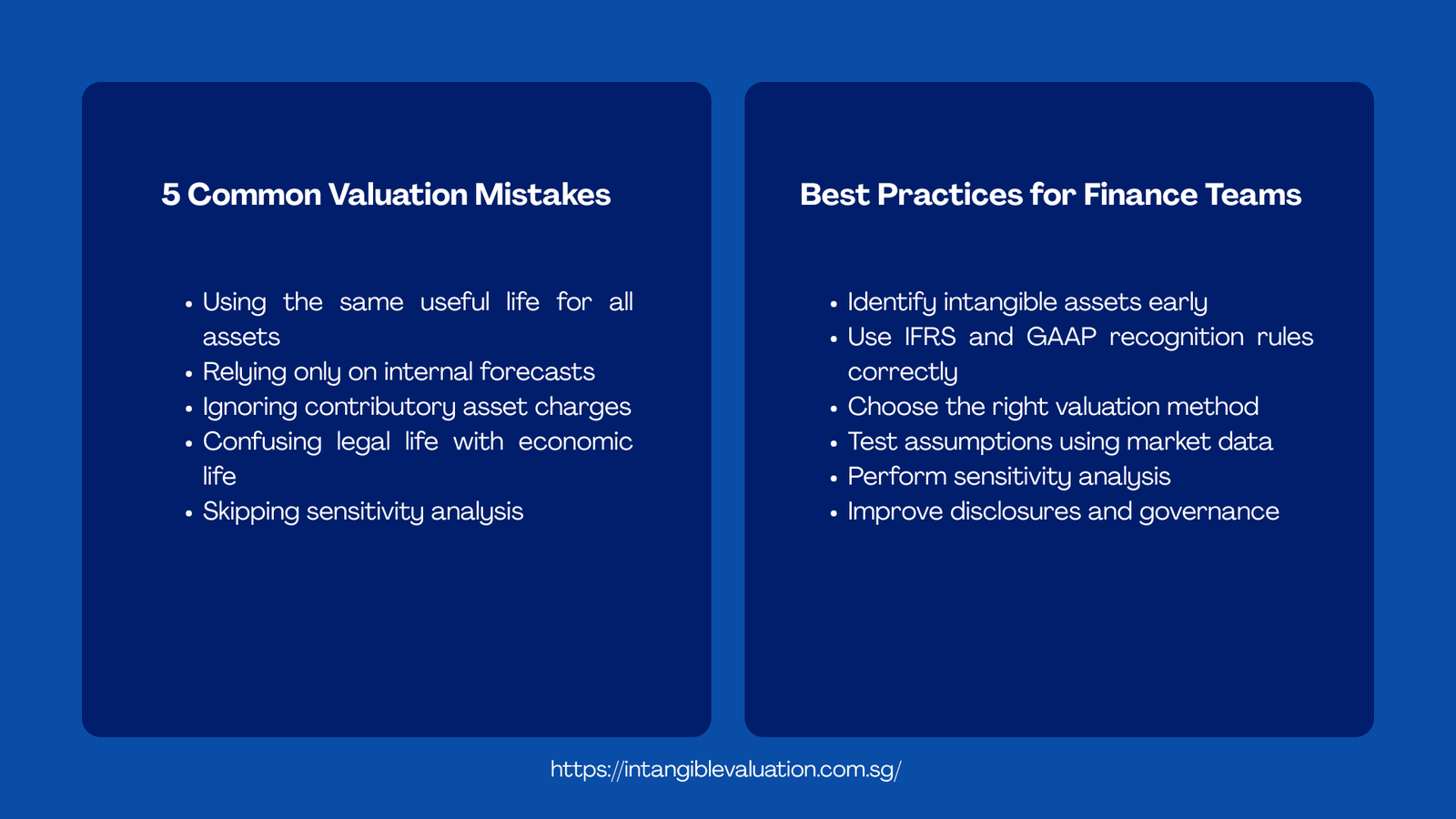
5 Common Mistakes in Valuing Intangible Assets for Companies
The five issues, as follows, are the most common practice failures. They are based on professional experience in the deal advisory environment, the audit environment and the regulatory environment, and they are applicable in industries and geographies.
Table 1: 5 Common Mistakes in Valuing Intangible Assets for Companies
| Error | Description | Common Impact |
|---|---|---|
| Ignoring useful life differences | Using one useful life assumption on a variety of intangibles. | Amortisation misstated; overstated balance sheets; assets. |
| Using internal data only | Using management forecasts alone, which are not corroborated by the market. | Unrealistic forecasts; risk of impairment. |
| Omitting contributory asset charges | Not able to strip out returns that are caused by other assets in the income method. | Overstated intangible value |
| Conflating legal life with economic life | The assumption of the value of an asset is as long as the law of existence of the asset. | Incorrect amortisation schedules |
| Skipping sensitivity analysis | Failing to test the change in value in the case of varying assumptions. | Unnoticed scope of misstatement; audit problems. |
The initial mistake – not taking into account the differences in useful life – is misleadingly widespread. A firm can put on a blanket ten-year useful life on all intangibles that were obtained in a transaction merely because it is a round number or an industry standard. As a matter of fact, a list of customers in a high-churn SaaS company can have an economic life cycle of three to four years, and a patented drug formulation can be able to yield returns of fifteen years or more. Mixing up of these results in systematic misstatement.
The second mistake is using internal data only, and this can be very risky, especially in the M&A environment. It is an inherent behaviour of management teams to put forward optimistic revenue forecasts, particularly when it is a competition-based auction. Those valuers who believe such projections without keying them to industry data, peer company performance, or analyst consensus are prone to come up with valuations that cannot stand the test of post-deal scrutiny. There are a number of post-acquisition impairment charges which can be traced back to this very failure mode.
The other three, four, and five are more technical yet significant mistakes. Excluding contributory asset charges -reflecting the utilisation of tangible assets, working capital and assembled workforce in the generation of cash flows that can be attributed to the intangible- exaggerates the stand-alone worth of the intangible under measurement. A combination of legal and economic life results in amortisation schedules which are not related to the rate at which the asset really depreciates. The lack of sensitivity analysis would still cause both the management and auditors to be not in a position to comprehend the extent of defensible values, which is a significant warning sign in any business valuation exercise.
Process Failures in Intangible Asset Valuation for Companies
A valuation is non-failing. It is unsuccessful because the procedure of it is improperly structured or not consistently executed, including the data collection, the assumptions examination, and its governance. The following table represents a solid intangible assets valuation process and the areas where errors are likely to be introduced.
Process Flow 1: Intangible Asset Identification and Recognition
| Step | Action | Expected Output |
|---|---|---|
| 1 | Carry out an asset identification session with the deal team or the finance heads. | Possible preliminary list of intangibles. |
| 2 | Use the IFRS 3 / ASC 805 criteria: future benefits are identifiable, controlled and measurable. | List of intangible assets that are recognisable and confirmed. |
| 3 | Categorise each asset as one of the following (marketing, customer, technology, contractual, artistic). | Asset classification matrix |
| 4 | Collect past financials, contracts and customer information as inputs to the valuation. | Verified data package |
| 5 | Valuation method: Select a suitable method to value individual asset classes. | Methodology selection memo |
| 6 | Evaluate and record all assumptions and substantiate them. | Draft valuation report |
| 7 | Carry out sensitivity analysis and peer benchmarking review. | Final validated valuation |
Practically, Step 1 is omitted or hastily performed too frequently. At the due diligence stage of a transaction, the deal team may put a lot of emphasis on the financial performance and intangible asset identification in the late drilling. This will squeeze the time to undertake the analysis appropriately and raise the possibility of missing the assets or underestimating their value. A missed intangible at acquisition causes the remaining amount to be charged into goodwill that is not amortised under either the IFRS or GAAP, which would otherwise be a real and amortisable cost.
Step 4 challenges are also very important. The most valuable assets of intangible-heavy businesses, such as technology companies, pharmaceutical companies, and consumer brands, are often informally held. CRM systems, which were not intended to be used to measure customer relationships, can be used to track customer relationships. Proprietary processes can be either recorded in bits or not at all. Even a technically advanced valuation model cannot be used to give reliable results when the underlying data is not strong.
Process Flow 2: Post-Acquisition Impairment Testing for Intangible Assets
| Step | Action | Expected Output |
|---|---|---|
| 1 | Determine cash-generating units (CGUs) to which the intangibles are assigned. | CGU mapping document |
| 2 | Identify impairment causes: market developments, performance underperformance, and legal problems. | Trigger assessment memo |
| 3 | Estimate recoverable amount (whichever of value in use and fair value is greater and less costs of disposal) | Recoverable amount calculation |
| 4 | Compare the recoverable amount to the carrying amount. | Impairment gap analysis |
| 5 | Note impairment loss and include it in the financial statements in notes. | Audited impairment entry and disclosure |
The most visible valuation failures are found in impairment testing, where many companies are found to fail. The annual goodwill and indefinite-lived impairment test of intangibles that are required in IAS 36 and ASC 350 require companies to estimate the future cash inflows of each cash generating unit. In cases where those projections are excessively optimistic (as they usually are where prepared by business units whose compensation is based on the value of assets), impairment charges are not recognised until they become unavoidable. The write-down by the time it is announced is usually so substantial as to cast serious doubts on the nature of what has been reported in previous periods.
Real Examples of Common Mistakes in Valuing Intangible Assets
The AOL Time Warner post-merger impairment story will continue to be one of the most helpful lessons of why companies overestimate or underestimate intangible assets in financial reporting. After the merger of 2001, the new organisation had both goodwill and intangible assets at values, which presupposed that the internet business would continue its unprecedented rates of increase. When the reality became radically different to those projections, the company realised a goodwill impairment charge of about USD 54 billion in 2002, in the course of which, it was one of the largest write-downs in the history of corporate. It is not just that the internet bubble has busted, but that in-house valuations, unless strictly tested against external market information, will lead to valuations that cannot be sustained in the long run.
An example that is more recent and educative is the case of handling the intangibles of relationships with customers in the telecommunications industry. Several of the European telecoms had customer lists that were recorded with values suggesting very low churn rates compared to the historic records. Where the actual churn rate had increased on a faster basis, due to market competition and modifications in regulation, the useful lives initially determined proved to be significantly overstated. Various jurisdictions, regulators and auditors thereafter required companies to change their amortisation policies, leading to restatements and further investigation by investors. This case is a direct example of the pitfalls of valuing intangible assets within businesses that are in the competitive and fast-moving consumer markets.
The research versus development versus expenditure has been a well-known area of mistake in valuing intangible assets under both the IFRS and the GAAP in the pharmaceutical sector. Among the patterns that have been well documented is the trend of companies to capitalise development costs of drug candidates that had not yet passed the regulatory and technical feasibility criteria to pass the IAS 38 requirements. As those projects later failed on clinical trials, the capitalised capital was forced to be impaired or written off, which resulted in the sudden and inexplicable changes in the statements of profit and loss. The moral of the story is that the recognition criteria are there because they serve to discipline against premature optimism, and by circumventing them, despite having good intentions, one presents financial reporting risk.
Table 2: Best Intangible Asset Valuation Methods by Asset Type
| Intangible Asset | Preferred Method | Key Inputs | Common Error |
|---|---|---|---|
| Customer relationships | Multi-period excess earnings | Turnover, sales, profitability. | Overstated useful life |
| Trade names/brands | Relief from royalty | Royalty rate, royalty revenue, tax rate. | Inflated royalty benchmarks |
| Developed technology | Cost approach or relief of royalty. | Replacement cost, obsolescence | Ignoring functional obsolescence |
| Non-compete agreements | With-and-without method | Revenue is lost in the event of the departure of a key person. | Underestimating competitive threat |
| In-process R&D | Multi-period excess earnings | Level of progress, likelihood. | Premature capitalisation |
Disclosure Failures and Governance Gaps in Intangible Asset Valuation
Although technically the valuation may be good, bad disclosure practices often compromise the usefulness of the resultant financial information. In both IFRS and GAAP, the companies must report on the methods and material assumptions that they apply to value intangible assets, the remaining useful lives allocated and on the outcomes of testing impairment. Practically, most of the companies have boilerplate disclosures which reiterate policy wording without providing investors with the information they require to evaluate the credibility of reported values.
The financial systems in place with regard to the valuation of intangible assets are often poor. The internal finance teams do not seriously challenge the way acquired intangibles are valued in most organisations, and ultimately it is left to external advisers. This forms a dependency which inhibits institutional knowledge and minimises the ability to question assumptions in future epochs. A stronger one is the presence of an internal valuation capability – or at least a finance team with some training on valuation principles – that critically interacts with outside advisers as opposed to merely taking their deliverables.
The importance of the audit committee is also not taken seriously in this respect. The auditors around the world have known intangible asset impairment testing to be one of the areas in financial reporting that pose the greatest risk, but are less likely to be given the board-level attention than capital expenditure approvals or treasury policy. Those companies that base the valuation of intangible assets as a compliance exercise instead of a substantive governance issue continually perform poorly compared to others in the quality and transparency of their financial reporting.
Conclusion: Common Mistakes in Valuing Intangible Assets for Companies
One of the most impactful and least understood fields of the present-day financial reporting is the valuation of intangible assets. The typical errors of intangible asset valuation of businesses audited in this article, such as failure to identify and over-relying on internal forecasts, inability to disclose assets and poor governance, are not isolated failures. They are industry-wide and geographical patterns that are replicated due to time pressure, the existence of misaligned incentives and general underinvestment in valuation capability.
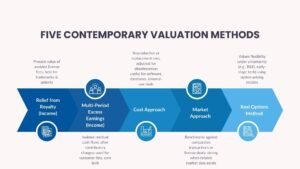
To gain the knowledge and authority in this field, the following are some of the steps that can be prioritised by professionals. To begin with, have a working knowledge of IAS 38, IFRS 3, IAS 36, ASC 350 and ASC 805. The key to all this is the understanding of the recognition and measurement principles incorporated into these standards, based on which all the others are built. Second, practise how to use the three fundamental valuation methods of the income approach, the market approach and the cost approach to various types of assets. The understanding of how to use a particular approach, as well as the reasons why a specific approach would be suitable in a certain asset type, is what makes a good analyst and a technically skilled approach user.
Third, have a healthy scepticism towards assumptions. When you come across a valuation (that has been prepared by an external consultant or otherwise) inquire whether the useful life is justified by empirical evidence relating to customer retention or technology obsolescence. Enquire about the revenue estimates being in line with industry estimates rather than what the management desires. And enquire about the sensitivity analysis being done and recorded. Such questions are not antagonistic; these questions are the epitome of professional rigour.
Lastly, be concerned with disclosure. The actual account of the valuation of intangible assets is recounted in the notes to the financial statements, or hidden. Organisations that provide their processes, assumptions and sensitivities in an open manner are an indication of trust in the processes. Those which offer template-driven, generic disclosures tend to have something that they would rather not have the investors inquire about. How to read and judge such revelations critically is an art that will see you through in any critical or advisory position. In most cases, the mistakes in the valuation of intangible assets between the IFRS and GAAP can be avoided. The first step towards their avoidance is to comprehend why companies over- or underestimate intangible assets in financial reporting – and resolve to do it better.