Which Method Best Values Digital Intangible Assets?
Understanding Which Method Best Values Digital Intangible Assets?
The assets of software, algorithms, data sets, digital brands and user networks now contribute to enterprise value more than factories or inventory ever did – but they don’t always have a clean market price attached. When it comes to technology valuation, M&A, or financial reporting, which method best values digital intangible assets is a question that every analyst has to answer at some point, as the number that comes out of the analysis may seem precise when in fact it isn’t a reflection of the actual value creation of the asset. The digital asset valuation is significantly different from the valuation of a factory or a trademark on a physical product: the creation of digital assets can be scaled without the proportional increase in costs, digital products are prone to rapid obsolescence and digital products can create value through network effects, which traditional valuation models run counter to. This article discusses the fundamental asset valuation techniques used, the added complexity of digital IP valuation, the importance of digital business valuation in the context of the larger picture, and some of the lessons learned from the implementation of these techniques with real Digital assets.
Which Method Best Values Digital Intangible Assets in a Fast-Moving Market?
It’s important to understand that digital assets are not like traditional intangibles in a few key ways, before you get to the question of which method best values digital intangible assets. The value of a patented industrial process may go on steadily and reliably for 20 years, whereas that of a piece of software or a data asset could be significantly diminished by a competitor’s development of a better product within the next few years, or even significantly increased by the widespread adoption of the new product at a faster than expected pace. This volatility also requires a much greater degree of scenario analysis and more carefully considered useful life assumptions than valued intangibles that have a more stable level of performance as a traditional product would. Analysts new to the digital intangible asset valuation process sometimes fall into the same trap as they do when valuing traditional assets: they apply a familiar, ten-year time horizon because it’s the “conventional” valuation approach, not because they truly believe that’s the period the asset is likely to last. It is not uncommon to hear senior reviewers in this space express the opinion that the quickest way to tell if an analyst is not experienced is to see when the analyst’s forecast period is based on a forecast exercise that was arbitrarily picked just because the evidence doesn’t support it.
The three general methods of all intangible asset valuation (income, market and cost approaches) also apply to digital assets, but each must be meaningfully adapted. The income approach requires cash flow projections that also incorporate the speed of rapid scaling-up and the risk of rapid decline; the market approach requires comparable transactions that are also hard to come by in this rapidly changing landscape of digital assets and deal structures; and the cost approach often undervalues digital assets because the cost to build a piece of software is not the same as the value of a functioning product with an established user base. For instance, a mobile gaming operator acquired by a bigger entertainment company was mostly valued based on the projected in-app purchase revenue and retention rates, and not on any development cost because the development cost had virtually no correlation with the earning power of the asset once it has reached a loyal player base. This example could also be useful to understand the reasons behind the preference of the income approach in the valuation of digital intangibles, especially when reliable forward-looking data is available, as is the case with the cost approach. The ones who have done this before, and have focused on how much it “cost to build” instead of on how much it has “achieved” in the market, quickly begin to gravitate towards income-based methods with every subsequent valuation of a target they look at.
What Asset Valuation Methods Apply to Which Method Best Values Digital Intangible Assets?
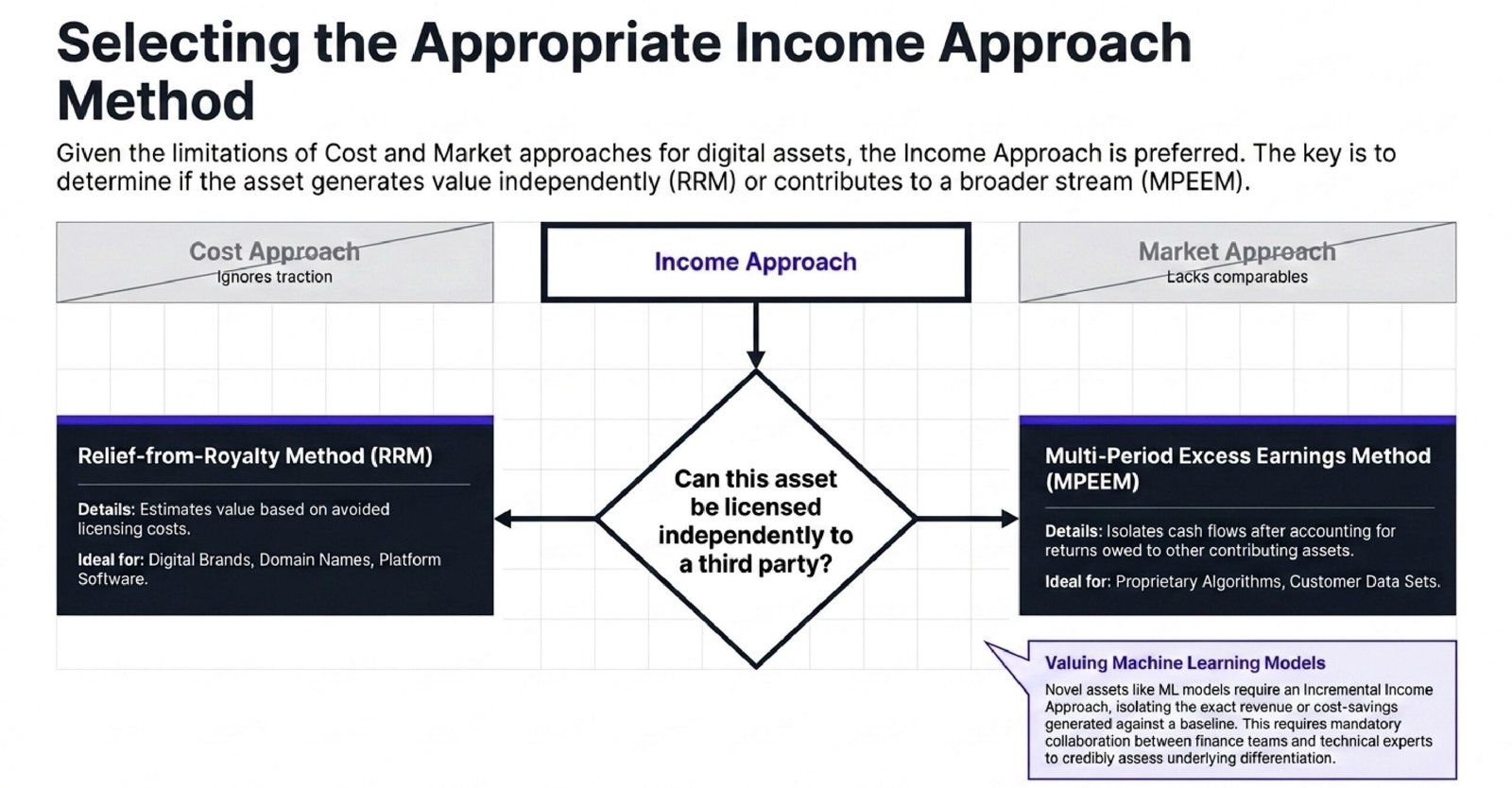
The relief from the royalty method and multi-period excess earnings method are two of the most commonly used methods of asset valuation, and they are more likely to be used in digital contexts than other methods, although they are more suitable for some assets than others. The relief from the royalty method is appropriate in cases of digital brands, domain names (where there is an actual comparable domain name market) and some software companies where the company would have to pay a similar royalty rate if it did not own the asset being valued. The multi-period excess earnings method, which identifies cash flows that may be attributable to the customer data assets specifically, rather than cash flows that may be attributable to other assets that contribute to the value of the business, such as the underlying platform or user interface, is more likely to work well for customer data assets and core proprietary algorithms. When valuating digital intangible assets, the choice of the one of these two leading approaches is often the most significant determinant of the final value, because errors in the other factors do not significantly affect the outcome if the wrong approach is used. Often, at the beginning of the process, it is good training for a junior analyst to pose a simple diagnostic question: can this asset be reasonably licensed to a third party as an independent entity, or is its value only in providing it in a package with other assets that are not valuable in isolation?
Also, a newer generation of asset valuation techniques has been developed specifically for digital assets that are difficult to neatly fit into categories such as large proprietary data sets or machine learning models that have been trained. The cost approach is now used in its modified form where the cost of a data set that could be legally acquired or created that provides the same competitive advantage as the actual data set is factored in, but increased to reflect the value of the data set’s competitive advantage. Others use an income approach, which doesn’t rely on the revenue numbers or cost savings from a machine learning model, but rather the incremental figures of a model versus some base case without the model, which requires very close collaboration between valuation analysts and the technical teams that truly understand how the model adds value to the business, and whose assumptions seldom come from a finance background. These newer approaches to valuation of assets are only beginning to become more standardized, and require considerable judgment and case-by-case approach, as compared to the more traditional approaches to the valuation of the other more prevalent asset categories. Over the last few years, professional valuation bodies have started to publish more specific guidance in this area, but practitioners believe the area is developing at a much faster rate than the ability of any one published standard to keep up with it.
Table 1: Asset Valuation Methods for Common Digital Intangible Assets
| Digital Asset Type | Typical Method | Key Challenge |
|---|---|---|
| Software platforms | Multi-period excess earnings method | Isolating cash flows from other contributing assets |
| Digital brands and domains | Relief-from-royalty method | Finding genuinely comparable licensing data |
| Proprietary data sets | Adjusted cost or income approach | Quantifying competitive advantage over generic data |
| Machine learning models | Incremental income approach | Requires deep technical input beyond finance alone |
| User networks and platforms | Market approach with adjustments | Limited comparable transaction data available |
How Does Digital IP Valuation Change Which Method Best Values Digital Intangible Assets?
The challenge of digital IP valuation is even more complicated than the basic questions that exist with respect to digital intangible asset valuation, in part because IP protection for digital assets is less straightforward than that of physical inventions. The traditional patent provides a well-defined, legally enforceable period of exclusivity, whereas software copyright, the protection of trade secrets for algorithms, and contractual data rights are all forms of protection with different attributes, and a valuator must account for these attributes in making risk and useful life assumptions. A digital IP valuation work must therefore take into account not only the current value of an asset, but also the extent to which the value can be protected against a competitor who can create a similar function without the encroachment upon any enforceable right. This defensibility issue is the culprit behind much of the negotiating brawl between buyers and sellers in the digital transaction process because buyers’ due diligence teams are charged with putting the technical differentiation of a seller to the test and sellers are looking to highlight its durability. The trademark and technology valuation sections of a data room typically tend to receive the most detailed follow up questions from experienced negotiators on either side of such deals.
Most practitioners narrow their digital IP valuation work to the five points below: First is the understanding of the actual legal protection available as a patented algorithm has a meaningfully different risk level than one protected by trade secret or contractual confidentiality. Second, the realisation of realistically assessing the technical differentiators, many software features that seem proprietary can be copied by a competitor if the resources in their possession are sufficient and the time is short enough. Third, the assessment of switching costs for those already in the system, as high switching costs can have an impact on the economic life of an asset even if there is no formal legal protection. Fourth, the lock-in effect of platform or ecosystem, in that case a digital asset that is deeply integrated into a vast platform has more value than a stand-alone one would have. Fifth, being explicit about the technological obsolescence risk in the discount rate or useful life assumption, rather than assuming stable cash flows indefinitely, as that might otherwise be true with a more traditional intangible. The systematic process of working through these five ideas, rather than jumping straight to a generic royalty rate or a discount rate based on an unrelated deal, is likely to yield a more robust digital IP valuation result that will bear up much better in negotiations or under audit scrutiny.
What Role Does Digital Business Valuation Play in Which Method Best Values Digital Intangible Assets?
Digital business valuation takes a holistic view of the enterprise, not valuing individual intangible assets in isolation, and the broader picture can help make the individual asset valuation work—which is covered in depth above in this article—more accurate. Other factors, such as monthly active users, customer acquisition cost to lifetime value, and network effect strength, do not fully represent the contribution of the underlying digital intangible assets to the overall value of a digital business and also indirectly influence the worth of the assets. For a social media analytics firm that was on the verge of being acquired, say, by Google, the key was to make sure that its digital business valuation work explicitly links user engagement scores to the value the acquiring company would put on the intangibles of the data and algorithm being offered. This relationship between enterprise value and asset value is one of the more unique aspects of digital business valuation relative to the more traditional, asset-based company where the relationship between enterprise value and asset value may be much more straightforward. Explicitly building this into the valuation story also helps the final conclusions to be easily defended to a board or investment committee that may be more used to metrics like user growth than the technical details of an excess earnings model.
The advantage of basing individual asset valuations on a wider digital business valuation context is that the total of the individually valued intangible assets and goodwill should be a plausible total for the business as a whole, based on what the business is worth. The problem is that digital business metrics can also be fickle, and it is possible to achieve short-term growth through marketing investment or promotion pricing, which superficially boosts user numbers but hasn’t captured the more true-to-form underlying value, so a careful valuator must take some time to look beyond the latest headline numbers and gauge what is actually sustainable. One of the more common reasons for overvaluation in faster growing tech businesses is a digital business valuation that is isolated from the unit economics of the customer acquisition or retention of the business. When unit economics is part of the standard work of the valuation process, as opposed to a separate diligence work stream performed by a distinct team, it invariably results in more disciplined and defendable results.
What Lessons Reveal Which Method Best Values Digital Intangible Assets in Practice?
In countless battles, just a few lessons emerge frequently enough to be considered as practical pointers for anyone who has to evaluate which method best values digital intangible assets in a given scenario. First, use the appropriate method for the actual value driver of the asset rather than fall back on the method that the analyst is most comfortable with because, if either method is not used, the figure will appear rigorous but will not actually reflect economic reality. Second, don’t rely only on finance professionals when valuing truly innovative digital assets, like proprietary algorithms or data sets, as the technical advantage is usually the most significant factor in the valuation process. Third, regularly re-evaluate assumptions that might differ from a traditional intangible, as the competitive and technological environment that drives most digital assets can change significantly within a reporting period.
But the most obvious takeaway is that digital intangible asset valuation is about being “with it” rather than simply using a familiar framework for every engagement, no matter the underlying business model. The valuator who has studied the economics of a subscription software company, data marketplace, and mobile gaming platform will create more believable digital IP valuation and Digital business valuation work across each of the three than one who uses the same formula in each. If you are on the path of becoming a junior digital professional, it’s better to develop a genuine curiosity around how digital business models really create and sustain value than to learn some static list of valuation formulas without developing an understanding for when they actually apply. This inquisitiveness, combined with a willingness to ask off-the-wall, technically uninformed questions early in an engagement, is what leads to the kind of practical judgment no textbook or training course can replace.
Conclusion: Key Takeaways on Which Method Best Values Digital Intangible Assets
The answer to which method best values digital intangible assets can vary depending on the asset, the level of legal protection it has received and the nature of its use in the context of the rest of the business’s value-generating activities. The next logical step for the professionals is to learn how digital intangible assets are disclosed and valued in the public technology sector, practise applying various asset valuation methods to particular types of digital assets, and develop real-world experience in the cross-over between digital IP valuation and digital business valuation. One of the quickest ways to develop sound judgment in this rapidly changing area of valuation work is to look at a few actual disclosures of tech acquisition, and consider why they selected a particular method for each digital asset identified. When tackled, this is an analytical challenge, not a daunting formula for intangible assets that don’t easily fit into any of the traditional asset categories. Repeat this process for a few of the company’s recent tech acquisitions, and you’ll develop a more nuanced understanding of the company’s disclosed digital intangibles, and why each specific approach was probably selected, than you would if you studied any particular valuation approach in isolation.