What Are the Differences Between IAS 38 and IFRS 3?
One of the most important technical accounting knowledge areas for financial reporting, audit and corporate finance professionals, and is one of the most frequently tested, is the difference between IAS 38 and IFRS 3. While both standards address intangible assets, they are used in very different scenarios: the first one is applicable to the recognition and measurement of intangible assets in the normal course of business, and the second one is applicable to recognition of intangible assets when a company is acquired. In fact, one of the earliest technical pitfalls for junior and mid-level professionals is mixing up the two, or assuming they’re the same, which is one of the most direct questions a technical interviewer or recruiter is likely to ask. To be able to discuss the differences in the accounting for IAS 38 intangible assets and IFRS 3 intangible assets with the same confidence as a more seasoned practitioner, this article outlines the differences and explains why.
What Are the Differences Between IAS 38 and IFRS 3 in Scope and Purpose?
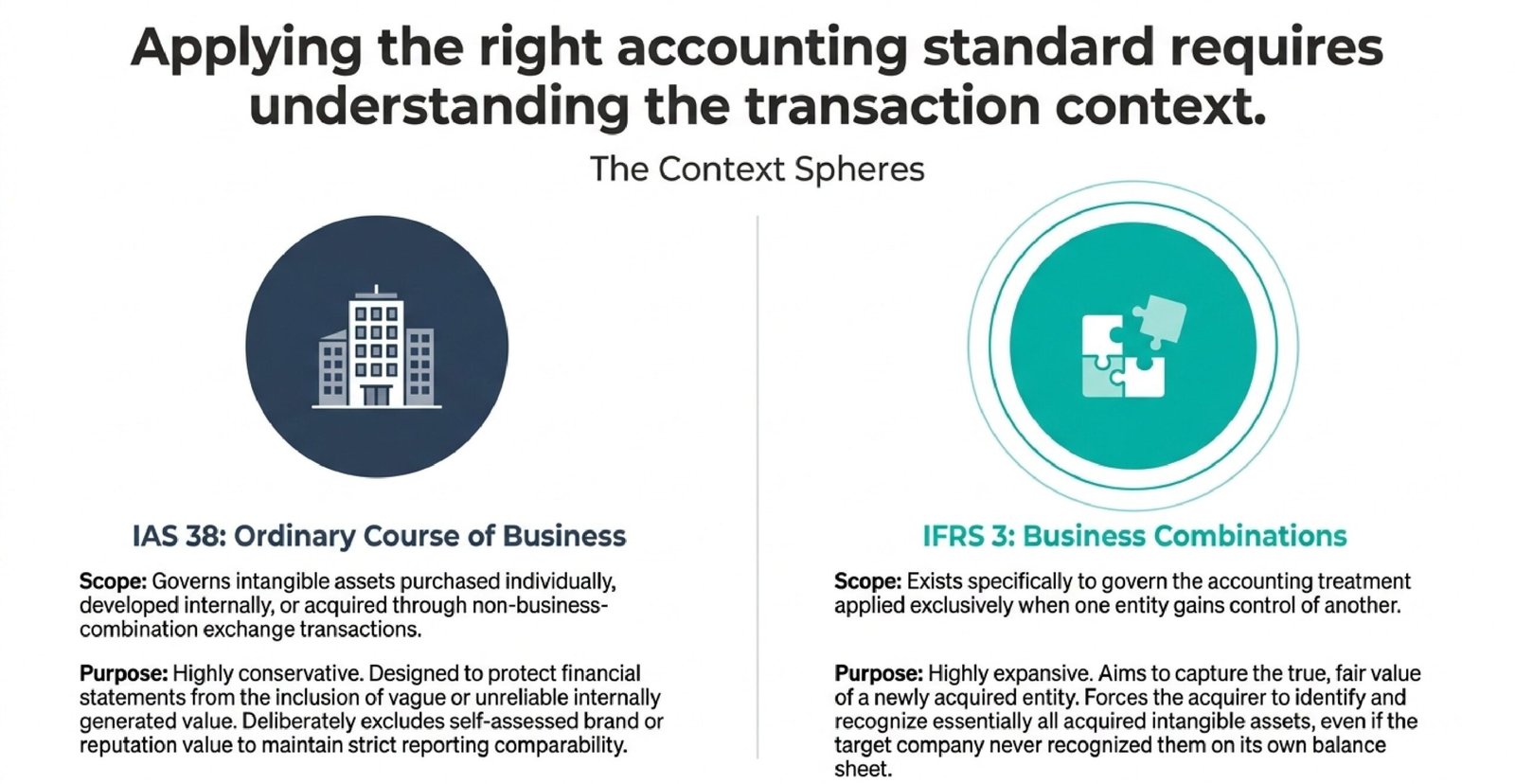
IAS 38 is the general standard for intangible assets in routine business situations, such as the acquisition of intangible assets in exchange transactions not involving a business combination, or the development of intangible assets by an entity. It is meant to ensure that only assets that have an objective and measurable value and have been recognized in the financial statements are included, in order to prevent the inclusion of subjective and unreliable internally generated value. This is because IAS 38 excludes from recognition intangible assets (such as internally developed brands, customer lists and self generated goodwill) even if management thinks of them as being valuable; the assets’ cost cannot be reliably distinguished from the cost of the development of the business as a whole. This is not an oversight; standard-setters determined that it would be inappropriate for companies to have discretion over capitalising self-assessed value of their brand and/or reputation.
IFRS 3 has, however, been created to cover accounting treatment for situations where one entity comes to control another in a business combination. It is meant for the opposite – the recognition of assets which are acquired, not just those that the acquiree was aware of and recognised when acquired under its own application of IAS 38. One of the most noteworthy differences between the two is that a company may never have the same underlying asset, say a customer relationship, on its books, but the asset must be recognised at fair value as soon as the company is acquired. This scope difference often is the most helpful mental rule of thumb for professionals new to either of these standards: if a business combination is involved, then the standard, and in the broadest sense, the correct recognition approach under the intangible asset accounting standards of the relevant standard, will generally follow.
What Are the Differences Between IAS 38 and IFRS 3 When Recognising Intangible Assets?
The two standards are different in many ways in terms of what they recognize and this is where many junior professionals make their first technical mistake. IAS 38 defines an intangible asset as an asset that lacks physical substance and is not a financial or investment asset. An intangible asset may only be recognised if it is probable that future economic benefits will arise from its use, and the cost of the asset can be reliably measured. This threshold is intentionally low and it is this reason that so many useful IAS 38 intangible assets – including brand reputation and the knowledge of the workforce that was developed internally and thus cannot be separated from ordinary operating activity – do not ever get onto the balance sheet under the general standard. The amount spent on research is expensed immediately and only expenditure incurred during a development phase which meets a technical and commercial feasibility criteria may be capitalised.
IFRS 3 allows for a much lower threshold for recognition in the particular case of a business combination. The elements of IFRS 3 intangible assets acquired in a business combination are presumed to always satisfy the probability recognition criterion and the fair value is reliably measurable because valuation techniques are assumed to be sufficiently developed to arrive at a defensible value. This means that an acquirer would be recognising far more intangible assets than the target company would have recognised on their own books, which is why so often acquisition due diligence and post-acquisition accounting reveals previously unrecognised value. One real-life implication of this relatively forgiving requirement is that the post-deal financial statement of the acquiring company will be a fairly different statement from a mere sum of the two pre-deal statements, which can sometimes throw even the junior folks off their game the first time it’s put into practice.
What Are the Differences Between IAS 38 and IFRS 3 in Measurement and Valuation?
There is also a significant difference between the two standards in the initial measurement. The recognition of intangible assets in accordance with IAS 38 involves measuring intangible assets at cost, which could be the cost of a separate purchase or the cost of an exchange transaction or development expenditure that is met the recognition criteria. Subsequent measurement is usually done in accordance with a cost model with an optional revaluation model seldomly adopted in practice, because of its need for an active market, which few intangible assets enjoy. This conservative measurement approach is consistent with the approach taken in the intangible asset accounting standards applied in accounting for intangible assets outside of business combinations, which emphasise on reliability rather than relevance, and is one of the reasons why users of the financial statements are warned against relying on the balance sheet as a true reflection of the economic value of the company’s intangible resources.
In a business combination, intangible assets transferred to the acquirer will be recognised at fair value at the date of the business combination, and not at their carrying value, if any, on the books of the acquiree. This fair value is the new cost basis for future measurements and all future measurements is then based on the general requirements of IAS 38, in most cases the cost model with amortisation over the useful life. The following handoff between the two should be remembered: IFRS 3 only affects the accounting for a business combination at the time of initial recognition, but the asset’s future measurement, amortisation and impairment testing is under the control of IAS 38. The table below illustrates these differences in measurement side by side, and shows the differences and similarities between the two intangible asset accounting standards after initial recognition.
Table 1: Intangible Asset Accounting Standards
| Intangible Asset Accounting Standards | IAS 38 Approach | IFRS 3 Approach |
|---|---|---|
| Initial measurement basis | Cost | Fair value at acquisition date |
| Recognition threshold | Probable future benefit and reliable cost measurement | Presumed satisfied if contractual-legal or separability criterion is met |
| Internally generated goodwill | Explicitly prohibited from recognition | Not applicable; only acquired goodwill is recognised |
| Subsequent measurement | Cost model, or revaluation model where an active market exists | Reverts to IAS 38 cost model after initial fair value recognition |
What Are the Differences Between IAS 38 and IFRS 3 in How Goodwill Is Treated?
Another major difference between the two standards is perhaps the most obvious: goodwill.Perhaps the most obvious difference between the two standards is goodwill, which extends from the larger intangible asset accounting standards mentioned above. Under IAS 38, no provision should be made for the recognition of internally generated goodwill, because the goodwill is not a resource for which a claim is identifiable, and the recognition is not reliable. If the management thinks there is value there, a company can’t just “capitalise” on it because it thinks there is value there.
The IFRS accounting for goodwill is much more rigid and it mandates that goodwill be recognized as a residual value when the consideration transferred in a business combination is in excess of the net identifiable assets acquired. An important practical connection between the two standards is the fact that a large number of intangible assets in IFRS 3 are identified and valued separately to minimise the amount of the goodwill figure which would then minimise the risk of impairment in future years. It is a matter of experience that professionals involved in the process of identifying intangible assets in a business combination quickly realize that if the identification process is poorly handled, goodwill will grow over time—and create problems for the finance team long after the business combination has closed.
Five Key Differences Between IAS 38 and IFRS 3 to Remember
The five points below summarise the most important differences between IAS 38 and IFRS 3 that professionals There are several key differences between IAS 38 and IFRS 3 that practitioners should consider when using these standards in practice, and the following five points summarize some of these differences.
- The scope of IAS 38 and IFRS 3 is different, with IFRS 3 being specific to assets acquired in a business combination and IAS 38 being specific to intangible assets acquired or generated in the ordinary course of business.
- Recognition thresholds vary: IAS 38 calls for probable future benefit and cost measurement to be reliable, whereas IFRS 3 does not require those two conditions to be met; it simply assumes that they are met when a contractual-legal or separability test is met, which reduces the recognition threshold in the acquisition context.
- Initial measurement varies: In IFRS 3 it is fair value measurement as of the acquisition date, in IAS 38 it is cost basis.
- There are two stark differences: first, acquired goodwill must be recognised and separately assessed for impairment under IFRS 3, while goodwill generated internally is not permitted under IAS 38; and second, the minimum of the two approaches is applied to goodwill.
- Interaction matters: The two Standards, IFRS 3 and IAS 38, are not two competing sets of rules but are two sets of rules that are applied in sequence: Once an intangible asset is recognised at fair value under IFRS 3, the measurement and amortisation of that asset is done under IAS 38
Real-World Examples of IAS 38 and IFRS 3 in Practice
A technology company that spent a number of years developing a customer ledger and a proprietary software system, with no costs recognised on its balance sheet because they failed to meet the strict criteria for recognition under IAS 38, and a significant proportion of the costs were classified as research costs and not development costs. As a larger competitor purchased the company, the acquirer’s finance team was faced with the obligation under IFRS 3 to recognise and value separately those previously unrecognised assets, namely the substantial customer relationship asset and the software technology asset that had never been on the target’s books. This case highlights one of the most obvious implementation differences between IAS 38 and IFRS 3 – the underlying value is not visible in one standard and required to be recognised in the other, depending purely on transaction context. It also serves to illustrate how it is essential for those individuals reviewing the financial statements of an acquirer to read both IAS 38 intangible assets rules and IFRS 3 intangible assets rules together as it is important to understand where the numbers came from in the financial statements.
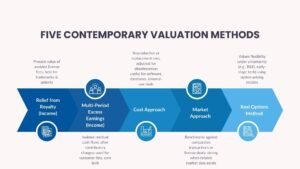
As another example, a manufacturing group had developed a strong brand recognition over many years but, in accordance with the strict recognition principles in IAS 38 Intangible assets, had never recognized value for the brand recognition. After being acquired by an international conglomerate the acquiring company had a valuation expert estimate the value of the brand using the relief-from-royalty method which recognised a meaningful intangible asset that would otherwise have been included in the goodwill on the acquisition. What is often surprising to the professionals who come across this difference for the first time, is that the significant brand value would not have been recorded on the balance sheet of the company, at least in the foreseeable future, without the acquisition, as per the accounting standards of intangible assets.
Benefits and Challenges of Applying IAS 38 and IFRS 3 Correctly
The knowledge of the differences between IAS 38 and IFRS 3 provides definite career advantage to accountants, auditors, and corporate finance practitioners. It helps establish credibility when talking about the allocation of purchase price, facilitates better financial statement analysis and provides an employer with the technical depth that is sought when hiring into technical accounting, audit, or valuation roles. Those who grasp the logic of recognising an asset that used to be invisible under IAS 38 intangible assets and are now on the balance sheet under IFRS 3 will find such knowledge helpful much more than just for the transaction team.
The problems encountered are just as authentic. The application of the recognition criteria under IFRS 3 will involve judgement, not least in applying the separability recognition criterion and in choosing a valuation method for an intangible that was previously not recognised. These judgements are often carefully considered by auditors, as the classification and valuation of IFRS 3 intangible assets impact future charges for amortisation and the risk of goodwill impairment. One of the more common lessons that has been learned over several engagements is that if intangible assets are under-identified in a business combination, it will lead to a higher goodwill value and a postponement of issues to future reporting periods; and if they are over-identified without defensible valuation support, they will lead to disputes with both auditors and tax authorities. In addition, professionals must be mindful that the further treatment of the asset is now governed by the general intangible asset accounting standards in IAS 38, such that the judgements made at acquisition will have a continuing impact on the reported earnings for many years to come.
Conclusion: Actionable Insights
These differences are essentially: IAS 38 applies to intangible assets of a general business and has a conservative cost-based measurement approach; IFRS 3 applies to intangible assets and has a much broader scope of intangible assets to be recognized on a fair value basis, specifically in a business combination. The obvious next step for professionals who are establishing a career in accounting, audit or valuation is to get comfortable with the recognition criteria in each standard, practise recognising intangible assets in IFRS 3 intangible assets, which would not be recognised under the general standard, but are recognised in IFRS 3 intangible assets when a business combination occurs and observe how goodwill is treated differently in the two standards. One of the most valuable technical skills today for financial reporting and transaction advisory professionals is the ability to apply these intangible asset accounting standards and the practical judgement which is required in applying them consistently.