What Is Patent Valuation and Why Does It Matter?
Many patents can be some of the most valuable and misinterpreted intellectual property assets owned by a company. Unlike cash or equipment, a patent cannot be valued on any invoice, and the value of a patent is determined through judgment, market data and financial modelling and often by a professional who must juggle legal, technical and financial considerations. But what is patent valuation, anyway? The way of calculating the economic worth of a patent in terms of its legal strength, business viability and the market it covers. This process is becoming more and more important to anyone who has a financial, licensing or IP management position—and anything that touches a merger price, court damages or anything else in between will inevitably be affected by patents, and often by the outcome of patent negotiations before anyone sits at the table. This article clarifies the importance of patent valuation, how it can help with patent valuation for licensing and takes practical lessons from transactions.
What Is Patent Valuation and Why Does It Matter to Businesses?
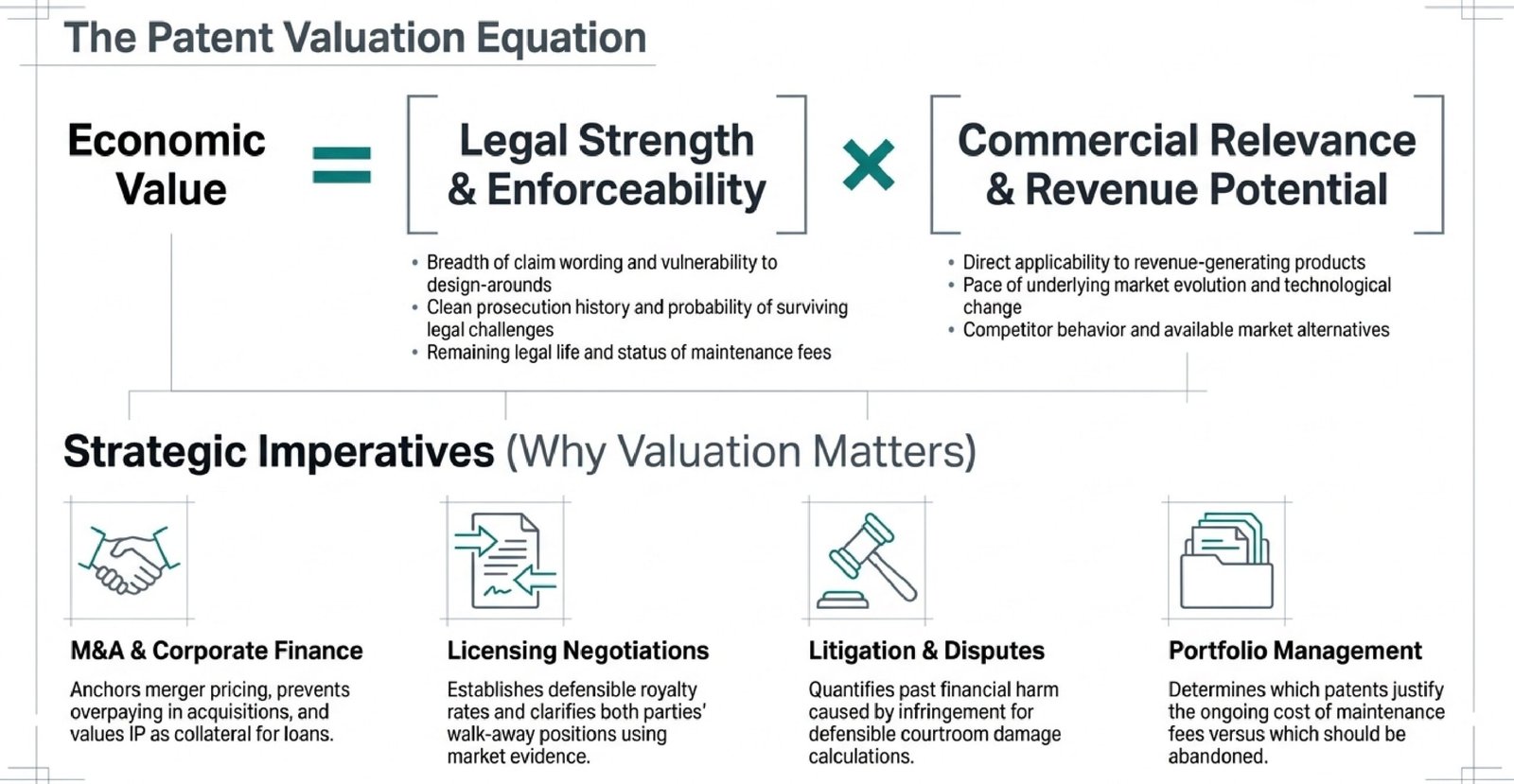
In other words, patent valuation is the answer to a seemingly simple query: What’s in a patent? Unlike a building or equipment, most patents lack a physical substance and a market price, as they each cover a different invention, have different claims, scope and legal lives. This is the very reason why patent valuation is more art than science, and two patents in the same industry, submitted in the same year, can be so very different in value depending on the extent to which the patents’ claims are drafted and to which degree the patented technology has become essential to the products actually being sold. However, in order to place a value on a patent, the valuation professional needs to consider the legal strength of the patent, such as the breadth of the claims and the likelihood of it withstanding a challenge, as well as the commercial relevance of the patent, that is, how much it relates to products or services that are used in the market to generate real revenues today and in the near future. Patent values can vary significantly between two patents covering apparently similar inventions based on the specifics, such as the wording of the claims, prosecution history and the evolution of the underlying market since the invention was first filed.
For businesses, this is important because patents are an increasing component of a company’s value, and as much as 90 per cent of the market capitalisation of certain companies, such as those in technology, pharmaceuticals and advanced manufacturing, depends on their patents. Whether it’s a company negotiating a merger, defending against a lawsuit, obtaining a loan based on the technology it owns, or licensing the technology to a partner, a credible number is essential to get the ball moving and will have to withstand attacks by opposing counsel, auditors, or even skeptical investors, who will not simply take a number on faith without being given a thorough explanation of how it was arrived at. If companies don’t have an accurate valuation, they may not get to the point of selling great innovations for the right amount, overpay in an acquisition, or be at a disadvantage in a licensing agreement because they can’t tell the potential value of their patents in terms of money. Even companies that do not intend to license or sell a patent can benefit from knowing the value of a patent because many of these companies go through the expense of having to maintain them while their patent value may be declining and not worth the cost of defending.
How Does Patent Valuation for Licensing Differ From Other Valuation Contexts?
Although many techniques may be utilised for patent valuation for financial reporting, Litigation damages or a transaction involving a merger, the primary goal of the valuation is different. In the sense of licensing, it is typically to be able to figure out a reasonable, sustainable royalty or up-front payment that aligns with the value that the patent brings to the product of the licensee versus what the licensee could probably put together using another technology or design around the patent altogether. This is not in the litigation context in which the valuation is primarily concerned with the determination of the amount of past harm caused by infringement, nor in the financial reporting context in which the valuation is more likely to be directed by consistency with accounting standards rather than at the hand of negotiations over leverage. This means that instead of the valuation professional being an accountant looking to just come up with one figure to put on a balance sheet, he or she must also come to understand both sides’ walk-away numbers and the competitive options on the market. A valuation for the purpose of a licensing deal will also often be expressed in a range rather than a single point estimate because both sides will need to have a bit of leeway to negotiate towards their ultimate point, one that takes into account the relative bargaining power, as well as the economics of the patent itself. The one “take-it-or-leave-it” number can have a downside when it comes to licensing: either party might feel like they didn’t get a good deal in the process, but a range will put the discussion on an evidence basis instead of an opening number that must be defended at any price.
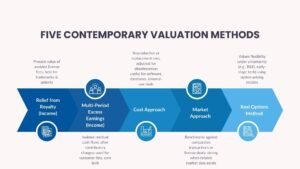
Professionals embarking on their first patent valuation engagement will find it helpful to review the four methods for valuing patents listed below and the situations in which each is likely to be most suitable, as well as its key limitation. Knowing which method to use when and what is not to be used when it is most applicable is the difference between the junior analyst and the trusted senior reviewer on a live deal, not which one is the most familiar.
Table 1: Patent Valuation Methods for Licensing and Intellectual Property Assets
| Valuation Method | Best Suited For | Key Limitation |
|---|---|---|
| Cost approach | Early-stage or defensive patents | Ignores commercial potential |
| Market approach | Patents with comparable licensing deals | Few truly comparable transactions |
| Income approach | Patents generating measurable revenue | Relies on uncertain forecasts |
| Relief-from-royalty | Patent valuation for licensing negotiations | Royalty benchmarks can be inconsistent |
The relief from royalty method is particularly used in patent valuation for licensing, as it calculates the natural anchor which a licensee would otherwise have paid a third party for the same rights. But seasoned practitioners hardly use just one of these techniques alone, and instead combine two or three methods, using one to cross-check another, to arrive at a defensible range of options to convince both sides of the negotiation. When valuing the product based on a single method, and not cross-referenced with a second approach, that is often the first thing a seasoned cross-negotiator will challenge when it comes to a discussion of the license.
What Are Five Key Steps to Valuing Intellectual Property Assets?
Experts who are asked to appraise a patent portfolio or even a single patent can go through a process to do that, instead of using a financial model without first taking the time to understand the legal and market context. The five stages outlined below are steps that are typically taken by IP valuation professionals to take a position from a legal confirmation to a defensible final IP valuation estimate.
First, determine the legal status of the patent and what the remaining term of its life is, including whether maintenance fees are up-to-date and if there are any challenges or opposition proceedings that are pending, because a patent that is subject to a legal dispute presents significantly greater risk than a patent that has a clean prosecution history. Second, determine the scope and validity of patent claims, as a patent claim that is too narrow can be readily designed around – a fact that frequently eludes the minds of inventors who are convinced that novelty is sufficient for good protection. Thirdly, search for similar licensing deals or industry royalty rates because the market gives them a crucial sanity check on any income- or cost-based estimate made by oneself. Fourth, assume future cash flows or royalty stream of the patent in realistic and evidence-based scenarios rather than in the best-case commercial scenario that might be the most favourable one the business unit or inventor might present, because inside the company,ny there are also strong reasons to give the most positive outlook possible. Fifth, use a proper discount rate that matches the technology, industry and patent’s remaining legal life due to the fact that a discount rate taken from another unrelated valuation can drastically affect the result. But of course, skipping the legal review step is one of the most common traps for the newer professionals, as it is easy to become enamoured with the technology and get to the financial analysis, only to find that the patent is unenforceable or has a too narrow scope of protection to make the financial analysis of any real value. The process works better from the ground up, by taking the five steps one at a time, rather than jumping straight to the modelling phase, because many aspects of the process will manifest themselves in legal or market information early on and either be fruitful and worth the time to improve or basically be of no consequence in the actual scope of the patent.
What Real-World Examples Show About Patent Valuation and Licensing?
Imagine a medium-sized medical device company with a patent for a new method of delivering catheters. The smaller manufacturer’s initial valuation of the item was based on a cost approach, which was intuitive to the finance team as it was based on hard facts and real costs that had been spent in the research and development process. During due diligence, the valuation team of the licensee identified that costs of development are not directly related to the commercial value of the product and recommended that an income-based approach be adopted that is based on expected unit sales of the licensed product. Eventually,y the deal included a respectable up-front payment and a continuing royalty based on actual sales, showing how the value of a patent for licensing negotiations can settle on terms that share the risks between the parties rather than on a single number that is agreed in advance. The smaller firm later said this risk-sharing arrangement turned out to result in a better financial return than the one it had sought at the outset, as the licensed product has been exceeding the licensee’s early sales forecasts for two years.
Another example is a technology firm which bought a smaller competitor whose main asset was a data compression technology for which the company owned the patent. Initial valuations were based on the assumption that significant licensing revenues would be generated from other industry players who would be interested in the technology, and that such projections had never been tested independently against the other industry players’ responses to the technology in the market. However, once the deal was made, it was noted that several competitors already had “workaround” technologies that didn’t involve the claims at all and dramatically curtailed the true licensing value of the portfolio from what was originally valued. That’s another case history that offers professionals working with intellectual property assets a valuable reminder: even a valid patent isn’t necessarily commercially relevant, and massively optimistic predictions of future licensing income must be subjected to stress tests in light of the fact that competitors will simply design around the IP. This was an eye-opening experience for the acquiring company’s finance team, who came to expect future IP acquisitions to undergo a thorough competitive landscape analysis, in addition to just the target’s commercial projections.
What Are the Benefits and Challenges of Valuing Intellectual Property Assets?
A credible strategy for the valuation of IP assets provides tangible benefits. It allows businesses to have a more robust valuation basis to support a licensing negotiation because it’s supported by market data and a clear valuation methodology, and not just a number from a party’s wish list. It also facilitates better decision-making within the company and a better understanding of what patents in a portfolio are worth and what is not worth defending, helping the R&D teams to make proper decisions on how to spend their resources. Among professionals, this skill is very transferable between jobs and helps to develop a unique and coveted set of legal, financial and industry-specific technical expertise; the combination is consistently hard to find in one person in the hiring process for these three major functions in the IP management, corporate development, and licensing sectors. It is also true that professionals who can articulate in a cross-disciplinary manner, like a claim construction problem to a member of a different discipline, like a finance professional, or a discounted cash flow assumption to a patent attorney, are very useful much earlier in their careers than those who are more narrowly trained in just one discipline.
The difficulties, however, are very great. The value of a patent is inherently hard to value, since the value of the patent relies on unpredictable events in the future, such as the behaviour of others who use the patent, the rate of technology advancement, and the eventual success or failure of any patent challenges to the patent’s validity. Comparable transaction data is frequently limited and/or confidential, as many licensing agreements contain non-disclosure agreements that do not allow the terms to be made public, and valuation professionals must resort to incomplete or indirect market evidence, which may be gleaned from court documents, surveys, industry records and/oranonymisedd benchmark databases. Further complexity is added by cross-border patent portfolios, where the same invention may be protected differently, or not at all, in different jurisdictions, and having a single valuation value for a patent portfolio can often be of little use if it is not broken down by territory. The risk of rapid technological change is also there, as when a patent is filed, it may have appeared to be a market opportunity, but, within a few years, the market may have decided on a totally different technical solution. For those who are new to the profession, the answer to these questions is to make sure that assumptions are clearly documented, that several valuation methods are employed to triangulate a range of value and not a single “definitive” value, and that the business unit or inventor making the commercial projections has a natural incentive to understate the value. Relationships with other technical subject matter experts and patent attorneys cultivated early in a practitioner’s career are also very beneficial in obtaining the most defensible valuations, because the best valuations are almost always the result of close collaboration between legal, technical, and financial perspectives, rather than the result of a financial model developed alone.
Conclusion
With a practical understanding of what patent valuation is and its importance, professionals can better understand and assist in patent licensing negotiations, mergers and IP disputes. A useful lesson for anyone entering the field of patent valuation is to not simply calculate out the value of the patent, but to instead consider every patent valuation as a legal analysis coupled with a financial model based on verifiable market data, reasonable commercial projections and a realistic understanding of the patent’s actual enforceability. Whether working in a patent valuation position or in other fields such as licensing or corporate finance, negotiating the valuation of patents is one of the most useful methods for establishing a reputation for early-career IP professionals. Innovation cycles are going to speed up in virtually every industry, and the ability to convert the technical and legal value of a Patent into a defensible monetary value will be a more valuable and more visible asset in the career portfolios of professionals at all stages of their careers.