Why Do Intangible Assets Fail During Business Valuation?
Understanding Why Do Intangible Assets Fail During Business Valuation
Intangible assets, such as patents, trademarks, customer relationships, software, and goodwill, can be the most valuable part of a company today, especially when compared to its physical assets and equipment. These types of assets are also the most difficult to confidently value, as they are rarely sought after in the open market and the benefits that can be expected in the future rely on assumptions that can change rapidly. If these assets are valued incorrectly, the effects of those errors are felt in mergers, financing choices, tax planning and financial reporting for years after the day that the valuation is done. This is crucial for anyone in corporate finance, accounting or valuation advisory, as similar pitfalls recur throughout the industries as well as across valuation cycles. In this article, the technical, structural and market-based causes of the failures are discussed, a real-life example is walked through in which valuation assumptions failed under stress, and common asset valuation issues facing practitioners in practice are discussed. Junior analysts and job seekers planning to embark on a career in intangible asset valuation should be aware of these potential challenges early on, to ensure they don’t end up with a work product that falls apart when it’s challenged months or years after it was completed.
What Does It Mean When Intangible Assets Fail During Valuation?
Intangible assets blow up the valuation when there is no evidence in the cash flows, in the market, or through contractual rights that it represents. That usually occurs when assumptions within a valuation model, such as growth rates, discount rates, customer attrition, useful economic life, etc., prove to be inaccurate as time goes on in the real business environment. A failed valuation is not necessarily a figure that is “dramatically wrong” on the day the valuation is signed; often, it is a number that on paper seems entirely reasonable, based on a clean model and a confident narrative, and fails a valuation on the day of a valuation, an impairment review, or a due diligence process, or even when the market sentiment changes. What makes an intangible asset failure even more perilous than other kinds of valuation error: it can only be discovered when a triggering event brings it to a person’s attention.
In the real world, issues with the valuation come to light in a number of ways: an unexpected and unpleasant goodwill or intangible impairment charge on an earnings call, an unexpected taxpayer disagreement with the external auditor at year-end on purchase price allocation, or a challenge by the tax authorities on a transfer pricing position based on an inflated brand or IP value. All these outcomes go back to the same underlying problem: the lack of alignment between assumptions taken at the time of valuation and economic realities thereafter. The gap can open gradually, as a market develops and growth levels off, or it can open up suddenly, when a market is hit by a competitive shock, a regulatory change, or the demise of a crucial customer relationship which the model had taken for granted would last forever. One of the most important skills to acquire is being able to identify these gaps at an early stage – not just after a restatement is needed.
Also, it should be noted that the failure in valuation is not limited to the finance function. A credit rating downgrade or a failure to defend an intangible asset against a regulator challenge can have repercussions beyond the books, from credit ratings to lending covenants and beyond that, confidence investors have in the management’s future forecasting prowess. Other employees and transactions pending that were depending on the original valuation as a reference point may also be impacted. That is why regulators and standard-setters have been working to raise disclosure requirements on intangible asset and goodwill valuations over the years, forcing firms to be more transparent about the judgment calls in the numbers.
Why Do Valuation Models Struggle to Capture Intangible Value?
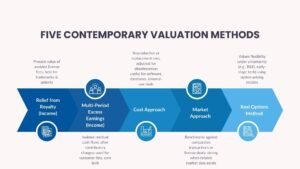
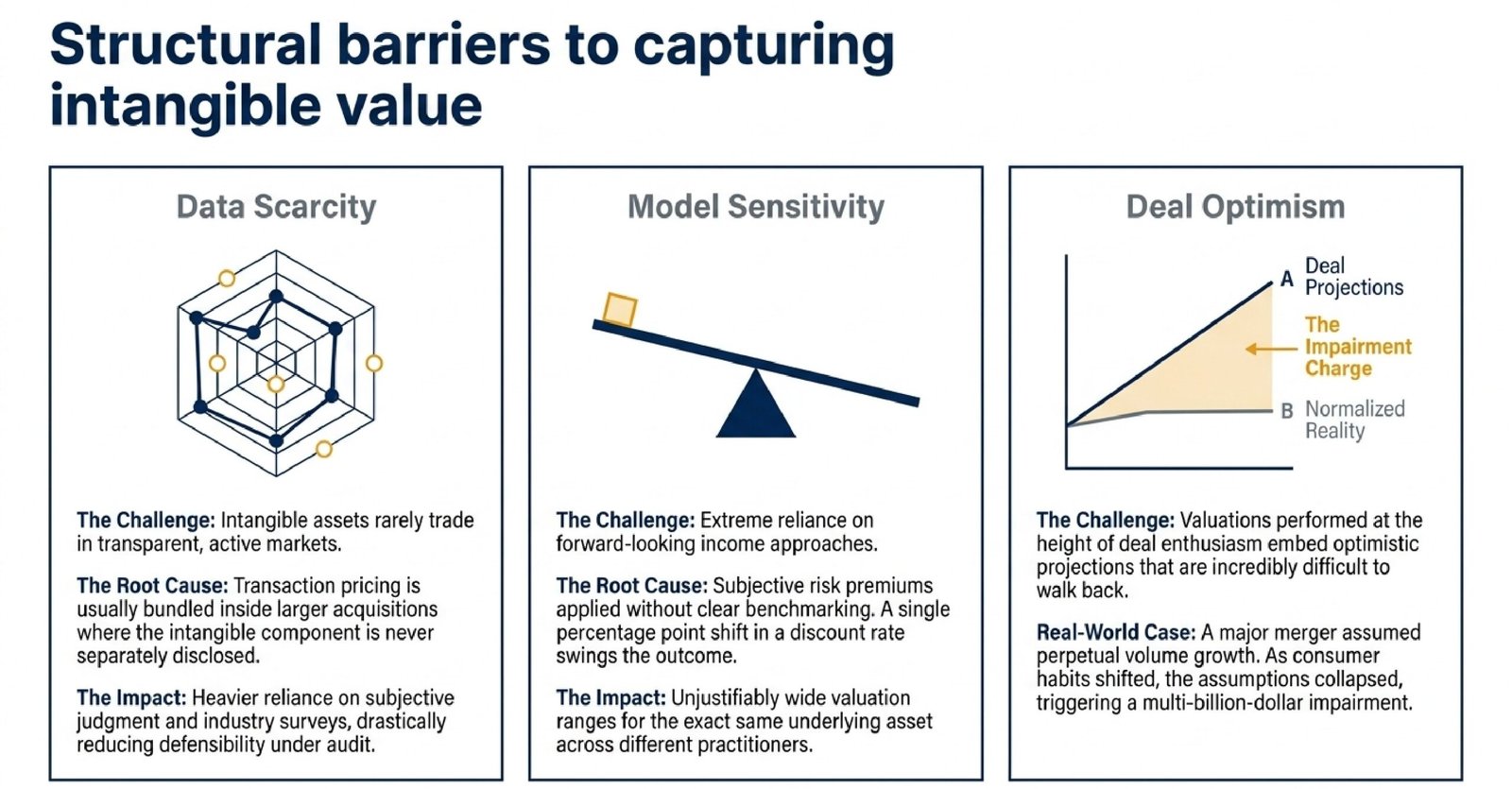
Intangible assets do not usually have a visible market where such assets are traded regularly on similar terms. This leads the valuers to over-depend on the income approach, which is based on the current cash flow from the asset over its expected useful life, or to use the relief from royalty method, the multi-period excess earnings method, or the cost approach. Each of these approaches is based on assumptions that are inherently uncertain: how long a particular customer relationship is likely to last, what royalty rate a willing, unrelated licensee would agree to in an arm’s length negotiation, and how soon a particular piece of technology is likely to become obsolete due to other competing innovations. The resulting value can vary widely with small changes in these inputs, such as a slightly more conservative attrition curve, or one percentage point decrease in the discount rate, among the more obvious of its many limitations—making it one of the underlying reasons that the value of the same underlying asset can be quite different between two equally competent practitioners.
The lack of similar transaction information adds to the difficulty. Physical assets are traded so frequently, and there is enough public information about these prices, that a valuer could easily be able to refer to a reliable market benchmark. Intangible assets like an algorithm or an internal customer base or a specific industrial patent do not trade like that, and when they do, the buyer and the seller rarely separate out the intangible asset and consider it a standalone transaction. One of the most persistent asset valuation issues in the profession is the absence of readily available pricing data; when such data are not available, it becomes more difficult for valuers to back up their argument, which must rely on more judgment, industry surveys of the royalities of assets, and sensitivity analysis in defending a position that is not subject to direct observation from an active market, such as a listed security or piece of real property.
What Do Real-World Intangible Asset Valuation Failures Look Like?
A popular illustration is a large North American packaged food company, which after a significant merger between two well-known consumer brands, had billions of dollars in goodwill and intangible assets (including trademarks and brand names) reported on its balance sheet. A few years after the transaction, the company took a huge impairment loss on the brands and goodwill, as actual growth was significantly lower than the expectations it had when the assets were acquired at the time of the deal. The original valuation was based on the assumption of continued increase in volumes and stable margins of its core brands, projecting that they would remain viable based on the historical trends of the time. At the same time, at least, consumers switched to higher-quality, less processed food categories and the retail pricing pressure from the big grocery stores increased, which made these assumptions unsustainable, and the carrying value on the balance sheet was not supported by the required impairment testing.
In many industries and at many points of the deal, valuations done when the deal is hottest tend to lock in deal optimism and are hard to unwind once they are part of a purchase price allocation and have to be reported to shareholders. It also illustrates the importance of continuing to monitor as much as it is important to be rigorous during the initial valuation. A perfectly sound model at the transaction date can become quite indefensible in a few reporting cycles if no one takes a second look at the underlying assumptions as market conditions, competitors react, or consumers change their behaviour. For analysts looking to make a career, the takeaway is that all intangible asset valuations are a live estimate and should be tested against actual results on a regular basis, rather than a one-off task completed at closing and put to the side until the next transaction. The same happened at technology and telecom firms that paid too much for platforms or customers when the growth was feverish, and have been forced to recognise the intangibles as write-downs when growth slowed down, making it a cross-industry risk and not just one exclusive to technology firms.
What Are the Benefits and Challenges of Getting Intangible Asset Valuation Right?
If properly done, intangible asset valuation provides management, investors and regulators with a defensible basis for decisions made based on it: a fair valuation price for the merger, financing based on intellectual property as security, purchase price allocation under IFRS 3 accounting standards and terms for royalties or licensing, which are defensible when challenged by an auditor or tax authority. Over time, a credible valuation will foster confidence with outside parties, which decreases the risk of expensive disagreements, restatements or extended negotiations further down the road of an asset’s lifetime. The ability to perform thorough, documented valuation exercises is a valuable skill for any professional – especially those in advisory and audit-related positions where the scrutiny of assumptions is part and parcel of the job. Both clients and employers remember who did well and who did not, in terms of the work that has stood the test of time, and the work that needed to be quietly shelved and revisited later.
The problems, though, are not imaginary and not going away simply because a team becomes more experienced. The listed challenges are only some of the asset valuation issues that practitioners will encounter on a regular basis, and are made even more difficult by several other factors that affect data, such as subjective growth and discount rate assumptions, fast technology cycles leading to shorter useful economic lives, and inconsistent application of accounting and valuation standards across jurisdictions. But add the commercial pressure that can arise from a deal team or management that’s already agreed on a transaction price, or a desired reporting result, and you’ll understand why keeping independence and methodological discipline is one of the more difficult and significant aspects of the valuation process. Knowing what to do to stand up to these pressures in a positive way helps younger professionals develop the habits that will result in work that will stand the test of time after the job is done.
How Can Professionals Prevent Intangible Assets from Failing in Valuation?
The first step in avoiding valuation failure is not to skip the assumptions step for a quick finishing touch at the end after you’ve finished the model, but to make assumptions the most important part of the process. Stress-test growth rates, discount rates, and useful life estimates with historical performance and independent industry figures instead of taking management projections on face value. It also means to explicitly explaining in the file why the inputs were taken as reasonable when they were selected, so that another party outside the original engagement, to whom the file is handed over one year later, when the auditor reviews it, or a new member of the team, can follow the logical steps and understand the reasoning.
Also critical is the inclusion in the plans of a formal mechanism for the review of valuations in the future, as opposed to this report being a ‘one-off’. Impairment testing is the tool used to detect a failing valuation before it fails in the open market in front of investors and regulators and should not be regarded as merely a box to be ticked once a year. The use of multiple approaches to cross-checking results, or the use of multiple methods of approach in conjunction where possible, also lowers the risk of assuming too much of one particular set of assumptions that may prove incorrect in the future. As long as this isn’t done as an afterthought after a draft report has been created, this shouldn’t greatly delay the timeline of a deal. Whatever the nature of the engagement – whether a small owner-managed business or a large cross-border transaction – the five points outlined below show steps that make a meaningful contribution in reducing the risk of the intangible assets failing during the valuation process.
Five Key Points for Stronger Intangible Asset Valuation
- Make inferences based on evidence. Use historical growth rates, industry benchmarks and available information from the marketplace when estimating base growth rates, discount rates and estimates of useful life, and be ready to articulate clearly the rationale for the use of each of these inputs.
- Take multiple approaches to valuations. If data are available, check results as they are compared across the income, market, and cost approaches; if there is a significant difference between these approaches, review the assumptions to determine if they are out of alignment; and, if they are, seek additional data from a different source to resolve the issue before drawing any conclusion.
- Record the “how and why”, not the numbers. When the position is later subject to an audit by a third party or tax authority, a valuation file should provide an explanation as to why each assumption was reasonable at the time.
- Re-Evaluate valuations periodically. Consider impairment testing and periodic reviews as an early warning system, rather than a compliance exercise, allowing for assumptions to be identified before they turn into a public write-down.
- Don’t be under any pressure from deals. The determination of the price of the transaction is separate from the valuation process to justify the price, as it is one of the most frequent ways the sound methodology is secretly compromised.
Common Asset Valuation Challenges and Their Root Causes
The table below provides a summary of recurring asset valuation issues that valuers or analysts may face depending on the type of engagement they are engaged in, the common circumstances in which they arise and the usual consequences that result when they go untreated. None of these problems are out of the ordinary or are even foreign. In fact, most valuation men and women will find these problems within their first few years in practice. Where a strong valuation team differs from a weak one is that they do not necessarily occur, but only if the team consistently adds mechanisms that identify the issues before they turn into a bigger problem like a public impairment charge or a disputed tax position.
Table 1: Common Asset Valuation Challenges – Why Do Intangible Assets Fail During Business Valuation?
| Challenge | Root Cause | Typical Impact |
|---|---|---|
| Overly optimistic growth assumptions | Projections driven by deal enthusiasm rather than historical trends | Future impairment charges once actual results fall short |
| Lack of comparable market data | Intangible assets rarely trade in transparent, active markets | Heavier reliance on judgment, reducing defensibility |
| Inconsistent discount rate selection | Subjective risk premiums applied without clear benchmarking | Wide valuation ranges for the same asset across practitioners |
| Weak documentation | Assumptions recorded briefly or not at all during the engagement | Difficulty defending the valuation under audit or dispute |
| Infrequent review after closing | Valuation treated as a one-time exercise rather than an ongoing estimate | Delayed recognition of impairment, amplifying the eventual write-down |
In all of these challenges, there is one common thread: Most valuation failures are process failures, not technical failures. It is very rarely that a discount rate that is negotiated without benchmarking, that is not tested by an independent party, or the documentation shortcut taken under time pressure is really a big deal at the time it is negotiated. The shortcut isn’t apparent and costly until later, when an auditor raises a probing question or a business falls short of expectations for two years. The placement of review checkpoints into the valuation process, and not just as part of the individual’s diligence, is what helps preserve the credibility of both the client and the profession throughout the professional’s career.
Why Do Intangible Assets Fail During Business Valuation: Conclusion
Intangible assets are the lifeline of the modern company, which is precisely why the risks associated with getting it right and wrong on their valuation are so great for all those who sign their name to the report: management, investors, and professionals. The pattern of failed valuations is rarely that on one bad day, the person who has to do the valuation makes a mistake, but instead it is the gradual buildup of overly optimistic assumptions, inadequate documentation, infrequent review and pressure, often “soft” and barely noticed, to drive a result toward a set goal. Each engagement should be viewed as a defensible, evidence-based estimate, not something that can be justified afterwards: Support assumptions with actual, verifiable data; Cross-check conclusions with more than one approach; Clearly document the reasoning for a stranger to follow; Revisit conclusions as market conditions and business performance evolve over time. That is what makes consistent work, one engagement after another, the best from the best and makes it a cautionary tale in someone else’s article years later.